On this page
Last Updated: 23 September 2026
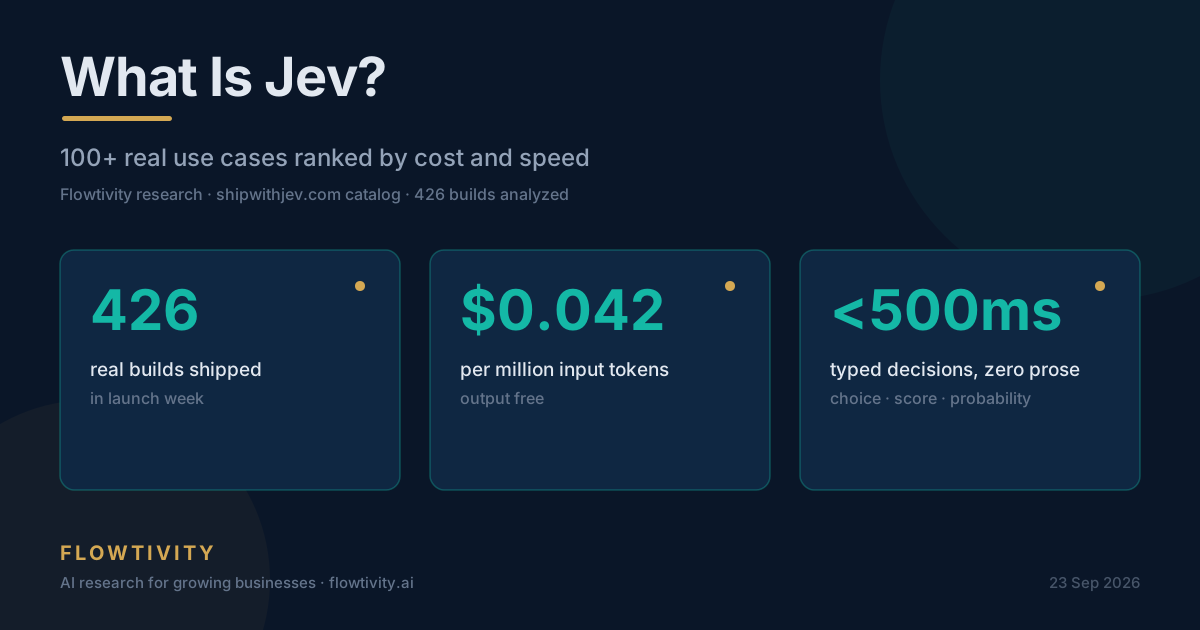
Jev is a decision engine, not a chatbot. According to the shipwithjev.com community catalog we pulled on 22 September 2026, builders have shipped 426 real projects on it, and the numbers they report are absurd by chat model standards: 500 emails classified for 3.5 cents, 724 ads torn down in 40 seconds for 9 cents, and a full browser flight search for 0.4 cents. We analyzed 110 of those builds with reported metrics and ranked them by scale, speed, cost and accuracy. The short version: Jev wins wherever an AI has to make the same type of judgment thousands of times fast, and it loses wherever you need prose, code or vision.
What is Jev and what makes it different?
Jev is the first public System One model from TypeSafe AI, launched mid-September 2026 by Diogo Almeida, a researcher behind ChatGPT and RLHF. You send it a state (structured or unstructured text) plus typed questions, and it returns decisions: a choice from a list, a score, or a probability. No sentences come back. According to TypeSafe, it runs 20 to 200 times faster and 40 to 400 times cheaper than frontier models, with answers in under 500ms. Community benchmarks peg input pricing around $0.042 per million tokens with output free.

Which Jev use cases have the best proven metrics?
Across our ranked sample, five use case classes dominate by evidence: classification and triage (cheapest per item), content and growth scoring (largest scale), browser agents (best full-task economics), real-time game agents (speed ceiling), and evaluation harnesses for other AI systems. The table shows the strongest reported builds in each class.
| Use case | Scale | Speed | Reported cost |
|---|---|---|---|
| Virality engine (SuperQode, 9,481 posts, 207 creators) | 61 questions per post | ~1s | $0.0004 per post |
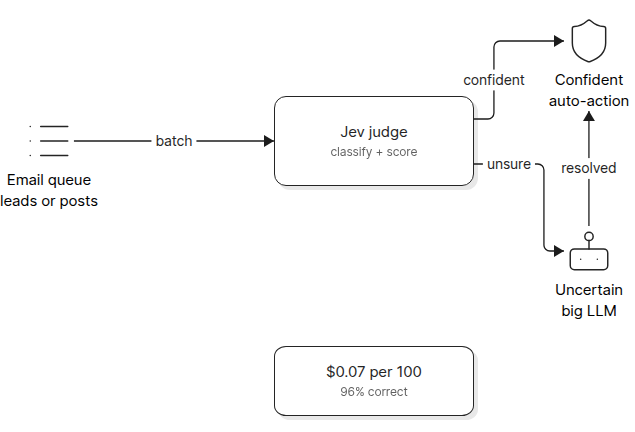
| Fraud pipeline (Jev + Kimi K3 fallback) | 100 emails | 1.42s | $0.07, 96% correct |
| Email classifier | 500 emails | seconds | $0.035 |
| Ad teardown (StealAds) | 724 ads, 37 brands | 40s | $0.09 |
| Lead outcome predictor | 700 leads | 40s | $0.09 |
| Browser flight search | 1 full task | 7s | $0.004 |
| Real-time Doom agent | 10 decisions/sec | 100ms each | ~$7/hour |
| X growth miner | 3,282 posts, 100M views | 8m 34s | $0.1282 |

According to the catalog authors, these are one-person builds shipped in days. "In 40 seconds it broke down 724 live ads from 37 brands, every hook, every format, offer, CTA, awareness stage, landing page mismatch. Used 9 cents of tokens," says Matthew Berman, creator of the StealAds ad library. That is the second signal in the data: the winning pattern is a thin Jev decision layer in front of data you already have, not a new product from scratch.
How much does Jev cost to run?
Reported whole-task costs in our sample range from $0.0004 to $0.13. According to a simulated robot fleet benchmark (300 real calls for $0.00737), Jev works out to roughly $0.042 per million input tokens with output free. At that price, continuous decision loops become viable: the Doom demo sustained 10 calls per second for about $7 an hour, a number that makes always-on monitoring agents economically rational for the first time.
Which businesses should care?
In our Flowtivity automation work with growing businesses, the highest-volume AI jobs are exactly this shape: which lead is hot, which email is urgent, which ticket goes to billing, which review is angry. Those judgments run thousands of times a day and never needed a frontier model's prose. Jev-class decision engines let a 20-person operations team run classification workloads for the price of a coffee per month, with uncertain cases routed to a bigger model. If you already have Make, HubSpot or Zapier flows making dumb if-then splits, a decision layer is the cheapest upgrade available in 2026.

What can't Jev do?
Jev is text-only, returns no prose, and cannot see images or browse. According to its own documentation and the catalog's limitation notes, it is not built for open-ended reasoning, long-form writing or code generation. The pattern that works: Jev decides, a chat model writes. The fraud pipeline that hit 96% accuracy used Jev for fast classification and routed only uncertain cases to Kimi K3.
The bottom line
Four hundred twenty six builds in one week is the fastest adoption curve we have tracked at Flowtivity. The metric-backed winners are classification, scoring and routing. If your business has a queue of anything (leads, emails, tickets, listings, posts), a Jev-style decision layer is now the cheapest, fastest tool for the job. The full ranked list of 100+ builds with sources is on shipwithjev.com, and our research method is simple enough to copy: rank by scale, speed, cost and accuracy the builders themselves reported.
One email a month, no noise
Practical AI notes for Australian businesses. Unsubscribe anytime.