On this page
- What is Plato's Key?
- How does one rotation let a model use another model's memory?
- What did the Stanford team actually measure?
- Is 41 per cent transfer accuracy good?
- Does the Platonic Representation Hypothesis survive the test?
- What are dark memories, and why does 18 per cent matter?
- Who is already shipping this?
- What does Plato's Key not prove?
- What should an Australian business do with this?
- Frequently asked questions
- What is Plato's Key?
- Can one AI model really use another model's memory?
- Does Plato's Key work with ChatGPT or Claude?
- What are dark memories in an LLM?
- Is Plato's Key production-ready for Australian businesses?
- How is Plato's Key different from model merging or distillation?
Last updated: 28 November 2026
Key takeaways
- ▪ Stanford's Hazy Research published Plato's Key on 25 November 2026, showing that one rotation plus one scale factor, fitted in closed form, lets a base LLM use another model's hidden state for a factual lookup.
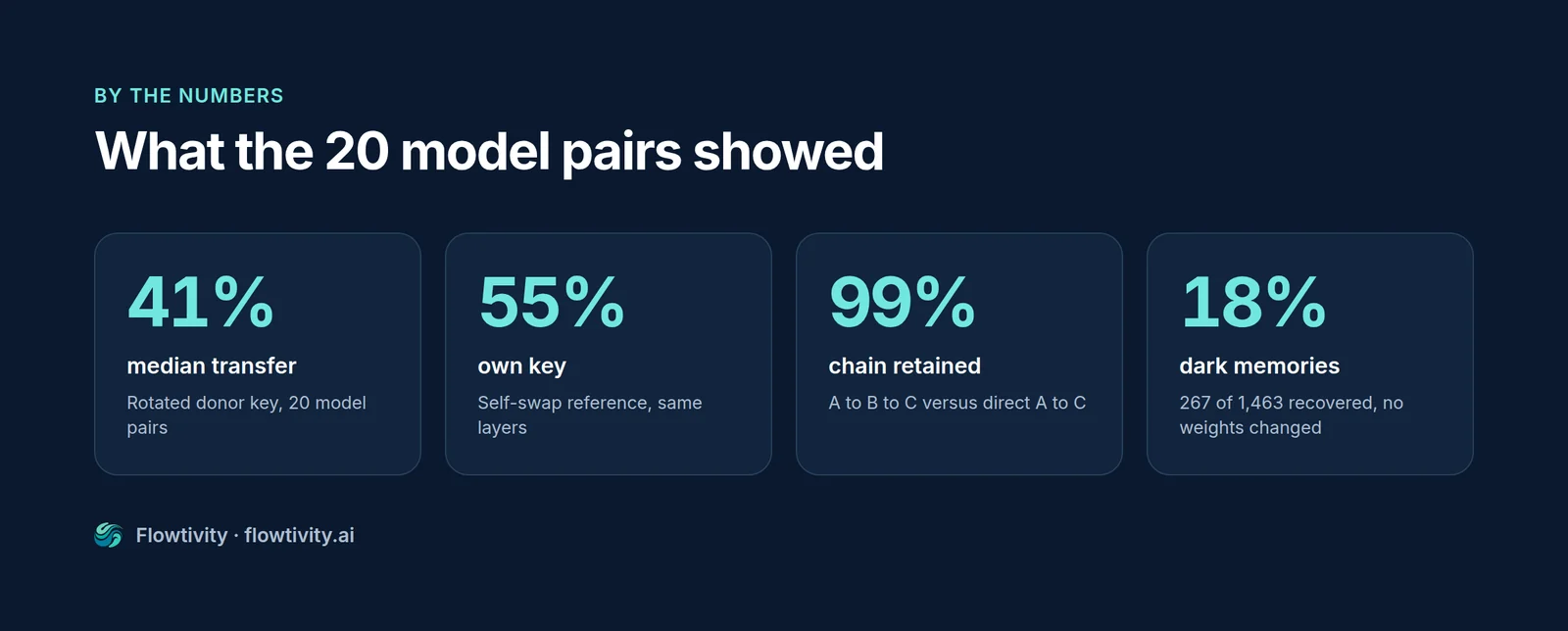
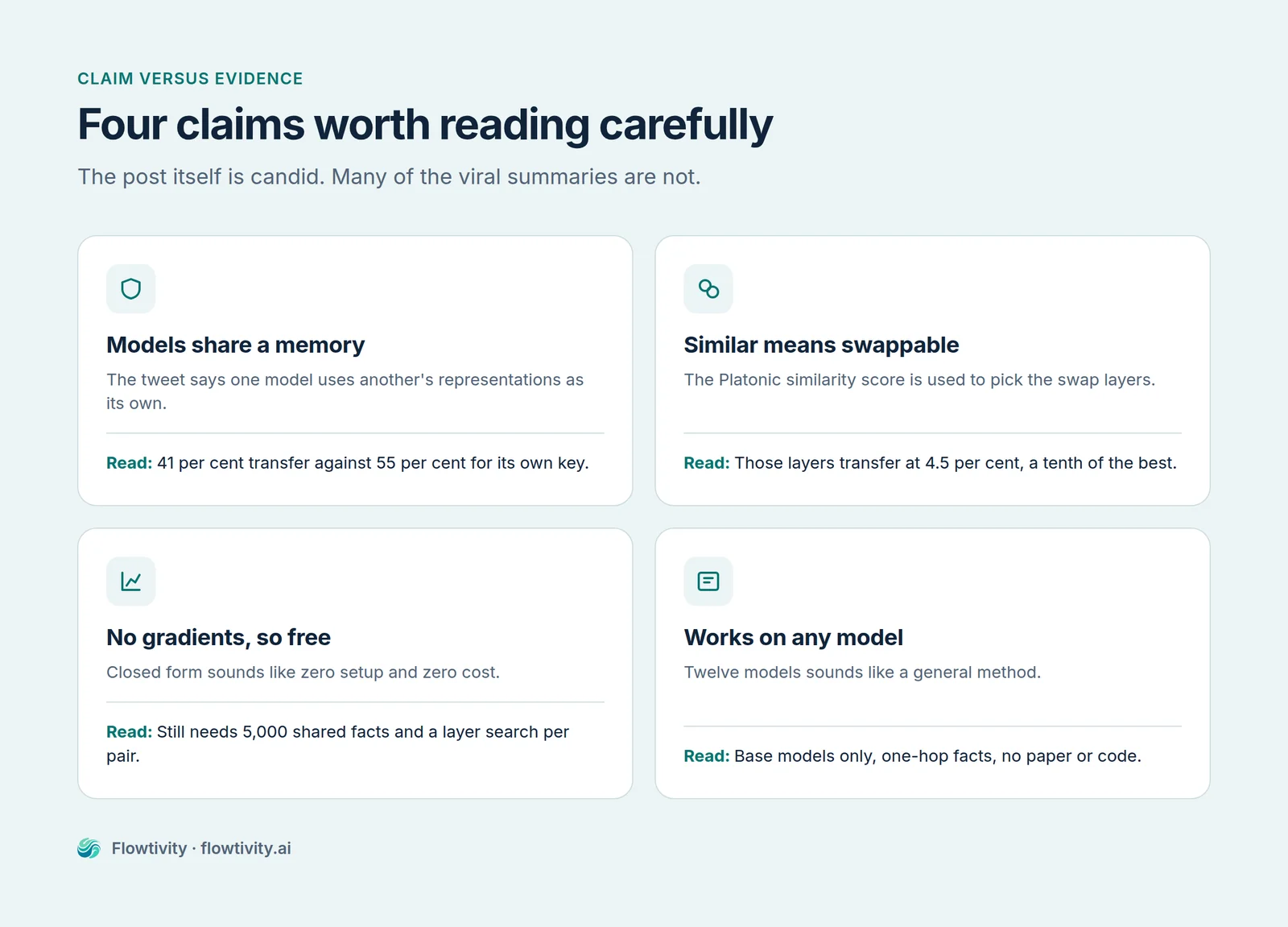
- ▪ Across 20 model pairs built from 12 base models, the rotated key produced the donor's answer in a median 41 per cent of swaps, against 55 per cent for the model's own key.
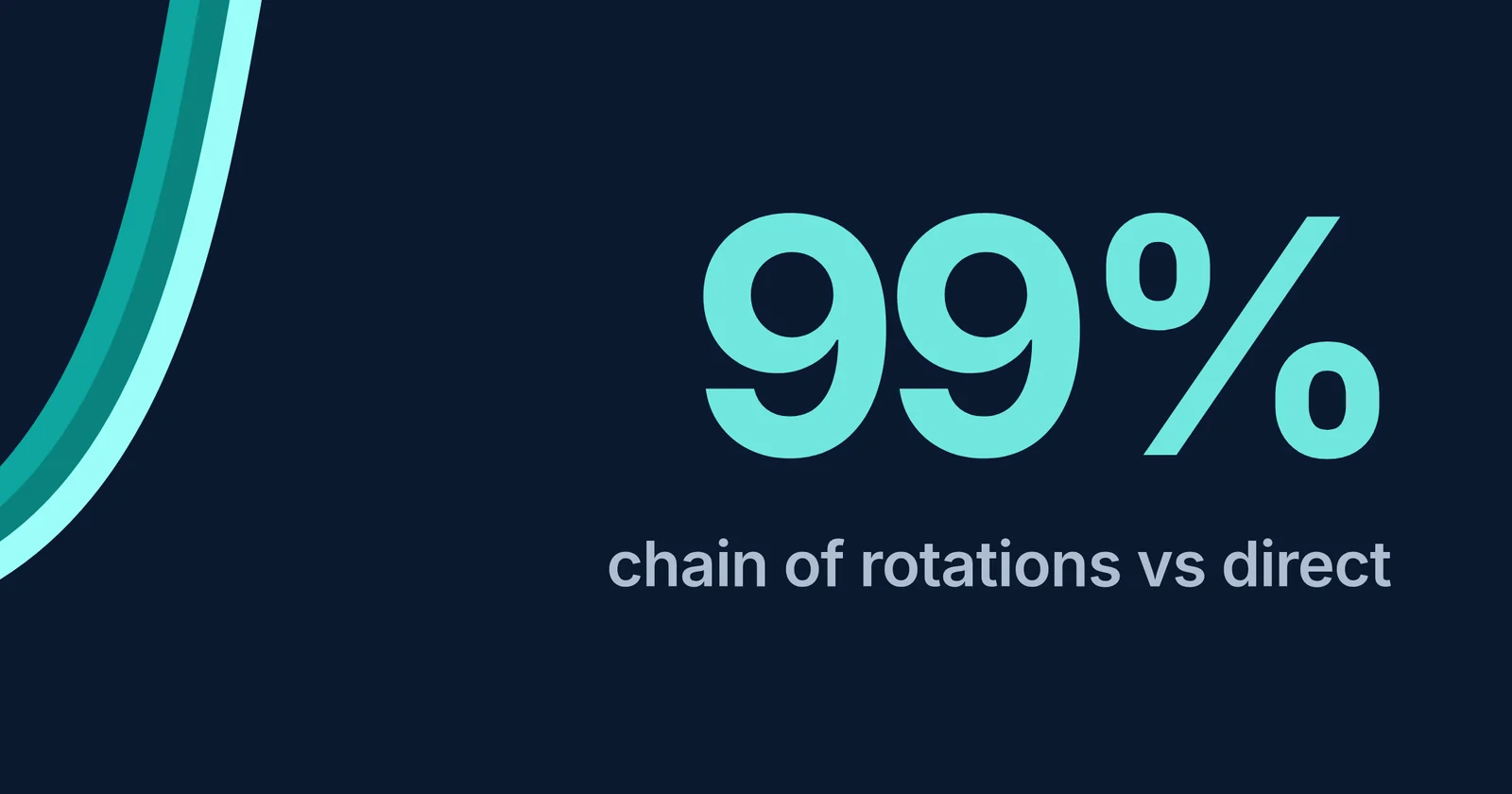
- ▪ Chained rotations keep 99 per cent of a direct rotation's accuracy, which is the strongest evidence yet that models are rotated views of one lower-dimensional space.
- ▪ The similarity metric behind the Platonic Representation Hypothesis picks layers that transfer at 4.5 per cent, about a tenth of what transfer-based layer selection achieves.
- ▪ A rotated donor key recovered 18 per cent of the recipient's dark memories, facts stored in its weights that its own key fails to reach.
- ▪ It is a blog post, not a paper, with no released code, tested only on one-hop facts in base models. The useful near-term application is text-encoder swapping, already shipping in ComfyUI.
On 25 November 2026, Stanford's Hazy Research published Plato's Key, an experiment that asks a blunt question about the Platonic Representation Hypothesis: if separately trained language models really converge on a shared picture of reality, can one model actually use another model's internal representation in place of its own? The answer is yes, and the map between them is one rotation and one global scale, fitted in closed form with no gradient descent. Across 20 model pairs drawn from 12 base LLMs, the swap changed the recipient's answer to the donor's answer in a median 41 per cent of test cases. The announcement tweet has been viewed 942,016 times and saved 7,944 times as of 28 November 2026, according to the post's own engagement counters.
The result matters beyond the headline. It separates two ideas that the AI industry has been quietly conflating: models that look alike inside, and models that can use each other's internals. The gap between those two ideas turns out to be large, and measurable. That gap is also the most useful thing in the post for anyone building with more than one model in the stack.
What is Plato's Key?
Plato's Key is a closed-form alignment method that maps the hidden states of one frozen LLM into the representation space of another, using an orthogonal Procrustes rotation plus a single global scale. It is fitted on fewer than 5,000 facts that both models already answer correctly, and it requires no training, no shared data pipeline and no access to either model's weights beyond their activations. The authors tested it on factual recall across 12 base LLMs from eight families, between 1.5B and 27B parameters, and reported a median transfer accuracy of 41 per cent against a 55 per cent self-swap reference.
The name is a nod to the Platonic Representation Hypothesis, the 2024 argument by Huh and co-authors that neural networks are converging toward a shared statistical model of reality, much as Plato described an ideal reality behind its shadows. That hypothesis had been supported mostly by similarity scores. Plato's Key tests it with a functional experiment: take a state out of model A, put it into model B, and see whether B's behaviour changes in the way A's would have.
How does one rotation let a model use another model's memory?
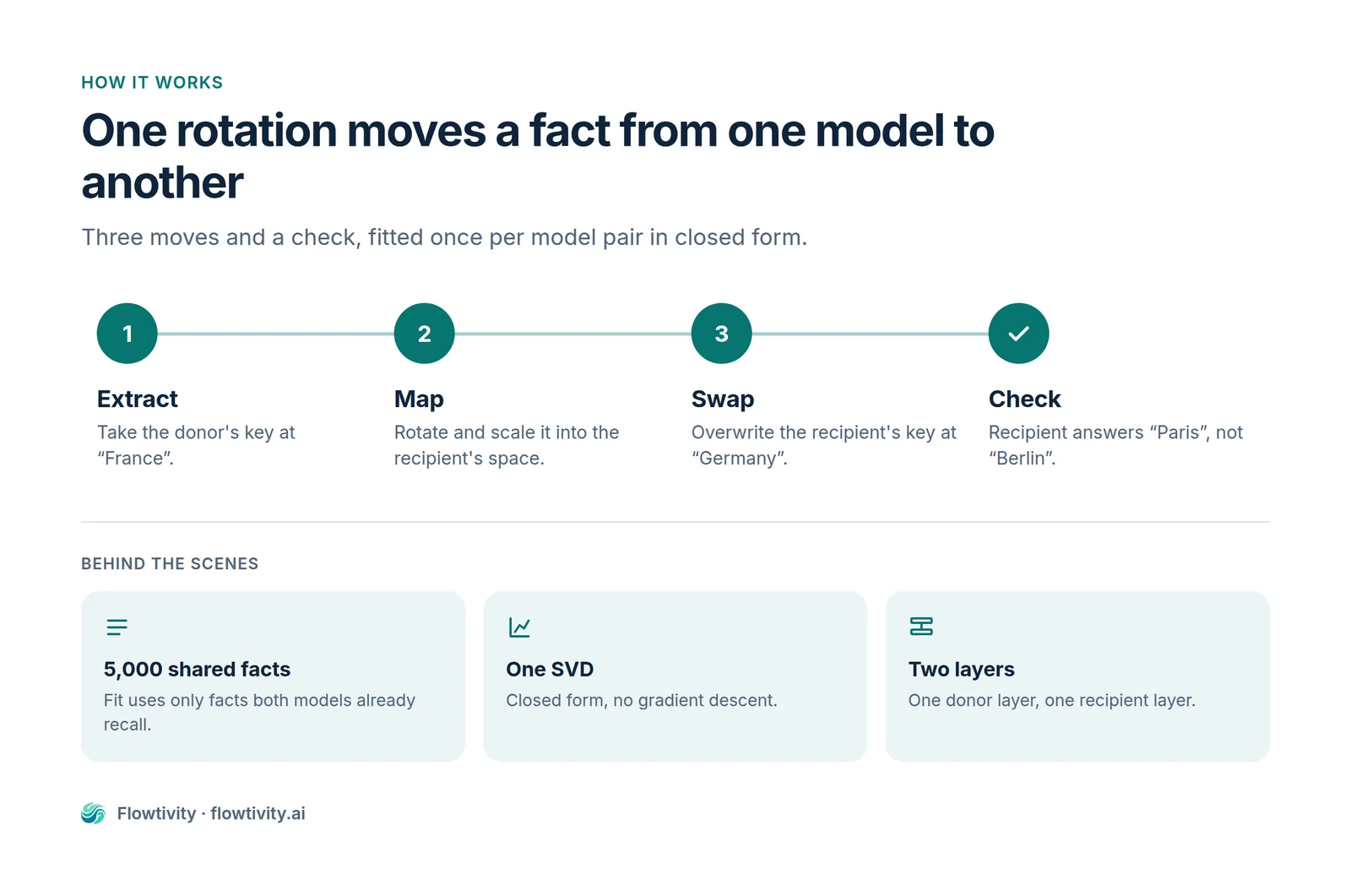
The mechanism rests on a well-established picture of how transformers recall facts, described in Geva et al. (2021) and Meng et al. (2022): early and middle layers build a key at the last token of a subject, and later layers use that key to pull the value, the answer, out of the model's weights. Plato's Key swaps only the key. The recipient reads "The capital of Germany is", and its key at "Germany" is overwritten with the donor's key for "France", rotated and rescaled. The recipient keeps its own later layers, so if it now answers "Paris", those layers retrieved a value from a key they never built.
The map is deliberately rigid. It allows rotation, reflection and, when the two models have different widths, a semi-orthogonal map. It does not allow stretching one direction more than another. The scale factor only matches overall spread.
zB = muB + s R (zA - muA), where R = UVT comes from a thin SVD of the centred key matrices and s = ||ZA||F / ||ZB||F.
That rigidity is the point. A trained multi-layer perceptron or a ridge regression has far more freedom and could fit the training facts more closely, yet the authors found those maps rarely transfer better, significantly beating the rotation in only 7 per cent of comparisons. The lesson is that the shared structure between models is close to a change of coordinates, not an arbitrary function.
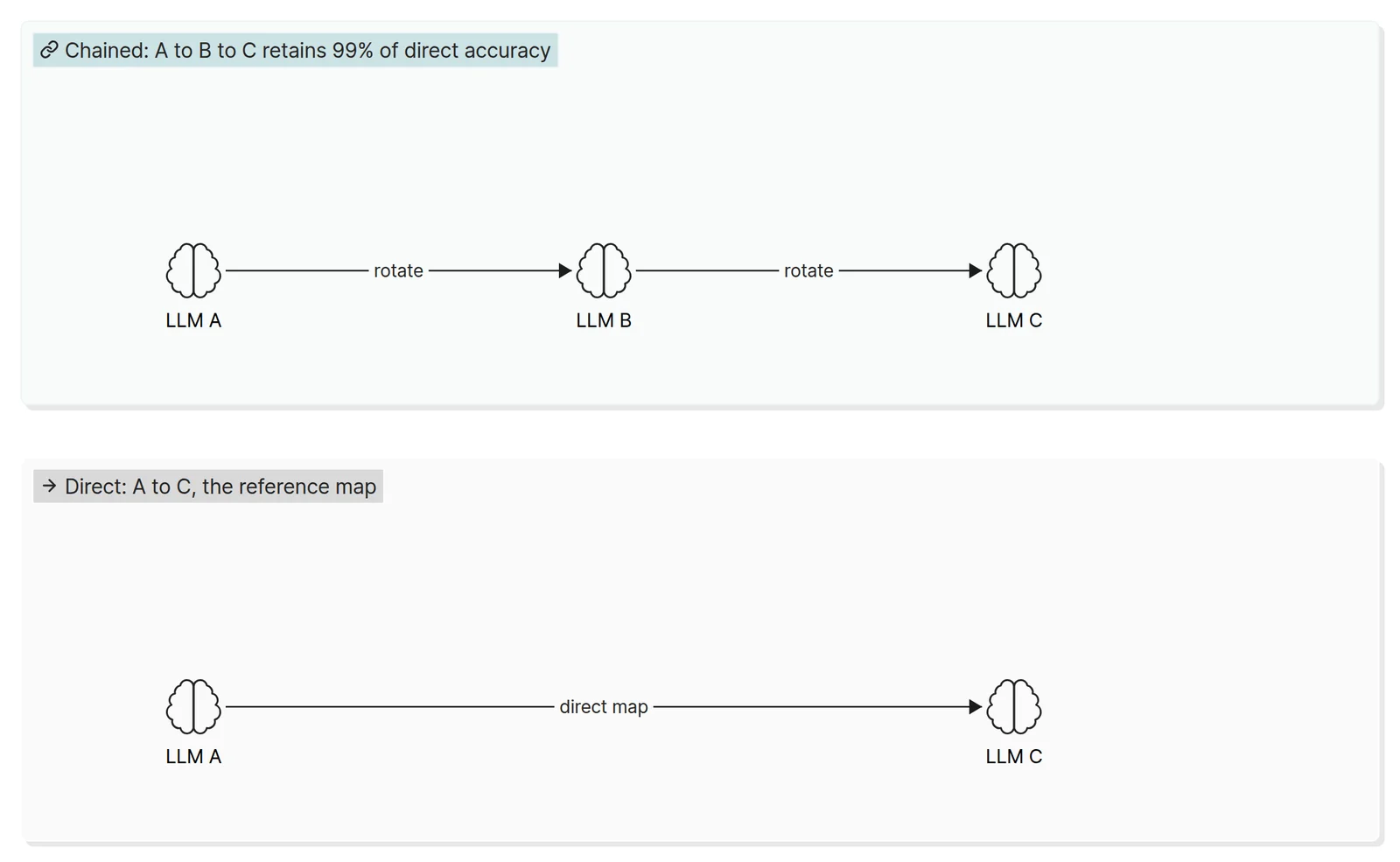
Because the map is rigid, it also composes. If each model needs only one rotation into a shared space, then a chain of rotations from A to B to C should land close to where a direct rotation from A to C would land. It does: across 47 chains the chained map retained a median 99 per cent of the direct map's accuracy, with 40 of 47 above 95 per cent and none below 92 per cent.
What did the Stanford team actually measure?
The test bed is 8,800 facts under 16 relations, such as capitals and authors, split by subject into training, validation and test sets. For each of 20 model pairs, the map is fitted on training facts that both models recall, the swap layers are chosen on validation facts, and results are reported on test facts whose subjects the fit never saw. Transfer accuracy counts how often the recipient emits the donor's answer after the swap. It is not the model's accuracy on the facts themselves, and that distinction is where most of the online commentary has gone wrong.
| Measure | Result | What it means |
|---|---|---|
| Models tested | 12 base LLMs, eight families, 1.5B to 27B parameters | Base checkpoints only, not instruct or RLHF-tuned models |
| Test bed | 20 model pairs, 8,800 facts, 16 relations | One-hop factual recall, split by subject |
| Rotated donor key | 41 per cent median transfer, range 34 to 46 per cent | The headline number |
| Recipient's own key (self-swap) | 55 per cent median | The honest baseline, not 100 per cent |
| Rotation as a share of self-swap | 73 per cent median, range 60 to 93 per cent | Cross-family 75 per cent, within-family 69 per cent |
| Best of 11 controls | At most 2.2 per cent in any pair | Random and shuffled rotations do not work |
| Layers picked by mKNN similarity | 4.5 per cent median | About a tenth of transfer-selected layers |
| Chained A to B to C versus direct A to C | 99 per cent median retained | 40 of 47 chains above 95 per cent, none below 92 per cent |
| Rotation in the top 256 principal components | 74 per cent of full accuracy | 4 per cent at 16 components, 87 per cent at 512 |
| Dark memories recovered | 267 of 1,463, or 18 per cent | No control recovered more than 1.1 per cent |
Is 41 per cent transfer accuracy good?
It depends entirely on the baseline you choose, and the authors chose a fair one. Self-swap replaces the recipient's key for "Germany" with its own key for "France" at the same layer. That still fails to flip the answer about 45 per cent of the time, because information about "Germany" remains in other tokens and in lower layers. So 41 per cent should be read against 55 per cent, not against 100 per cent. On that reading the rotation carries roughly three quarters of what the model's own key carries, and no pair's rotation beat its own self-swap.
The controls are the other half of the argument. The best of 11 controls, including random rotations and rotations fitted on shuffled fact pairs, reached at most 2.2 per cent in any pair. That is a wide margin, and it is what turns the result from a curiosity into evidence that a real geometric relationship is being exploited.
Does the Platonic Representation Hypothesis survive the test?
Partly, and the partial answer is the most interesting finding. The primary metric in the PRH paper is mutual nearest-neighbour similarity (mKNN): how much the nearest neighbours of an item overlap between two models' spaces. The Stanford team used that metric to choose which layers to swap. Layers chosen by mKNN transferred at a median 4.5 per cent, roughly a tenth of what layers chosen by validation transfer achieved. In their models the similarity score usually peaked within the first 5 per cent of the recipient's depth, while transfer peaked between 22 and 38 per cent.
That is a direct challenge to a habit the field has picked up: treating representation similarity as evidence that two models understand the same thing. Similar geometry does not guarantee functional interchange. CKA, another popular similarity score, is known to be sensitive to outliers and can be shifted without much change in behaviour (Davari et al., 2022). The Platonic claim survives in a weaker, more useful form: models appear to be rotated views of one lower-dimensional space, but the layers where they look most alike are not the layers where they can use each other's keys.
Sergei Parfenov, who replicated the recipe on three smaller models, put the distinction more sharply than the original post does: "A similarity score says two models look alike. A swap says one model can use what the other built."
What are dark memories, and why does 18 per cent matter?
Dark memories are facts a model stores in its weights but fails to recall on a direct prompt. The Stanford team collected 2,600 misses from their 20 model pairs and classified 56 per cent of them, 1,463 facts, as dark memories, using three checks: the model answers correctly when given three in-context examples, or under a paraphrased prompt, or when ranking the correct answer first among up to 50 candidates from the same relation. Swapping in a rotated donor key recovered 267 of those 1,463, or 18 per cent, with no weight update. No control recovered more than 1.1 per cent.
This connects to a 2025 result from Gekhman and co-authors, who found that three open-weight models encode more factual knowledge internally than they express externally, with an average relative gap of 40 per cent. Some answers were so deeply hidden that the model knew them perfectly yet never generated them across 1,000 samples. The practical implication is uncomfortable for anyone who has been promised that fine-tuning will fix a knowledge gap: if recall fails because the key is badly formed, more weights are not the answer.
The authors read their result as recall failing because of an ineffective representation rather than missing knowledge, and they link it to their own work showing that transformer MLPs behave like Hebbian memories, storing facts as key-value pairs. The caveat is honest: a swap cannot rule out that the donor's key carried the answer in with it, rather than unlocking a value already in the recipient.
Who is already shipping this?
Within a day of publication, developers were applying the rotation to a much more mundane problem: swapping the text encoder behind an image or video model. In ComfyUI, a MiniMax-H3 pipeline can now run on Qwen3.5 9B at 9.7 GB instead of the bundled Qwen3-VL-32B at 27.1 GB, with a single small safetensors file and no change to the diffusion model, according to the ComfyUI Wiki's write-up of the adapter on 26 November 2026. Similar key packs appeared for Krea 2, MOSS-Image and Z-Image within the same week.
| Encoder | Size | Adapter | Reported cosine |
|---|---|---|---|
| Qwen3-VL-32B (native H3 encoder) | 27.1 GB int8 | None, this is the reference | Not applicable |
| Qwen3.5 9B | 9.7 GB int8 | Linear key, same tokenizer | 93.05 per cent |
| Qwen3.5 2B | 4.5 GB bf16 | Linear key, same tokenizer | Not published in the summary |
| Qwen3.8 27B | 17.3 GB w4a8 | Linear key | Not published in the summary |
| Gemma 4 E4B | fp8 | Rank-32 LoRA plus key, cross-family | 97.6 per cent with LoRA, 90.1 per cent without |
Read those numbers carefully. They are token-level cosine similarity to the native encoder, not a quality score, and the adapter author's own notes say cross-family encoders without the LoRA garble spoken dialogue. Existing H3 LoRAs and accelerators were trained against the native encoder, so a swap can quietly degrade work you already have. Still, a 64 per cent reduction in encoder memory for a same-tokenizer swap is the kind of saving that shows up on a GPU bill immediately.
What does Plato's Key not prove?
Several things, and the authors are more candid about them than most of the coverage. The result covers one-hop facts only: a subject, a relation and an answer. Multi-hop questions, post-trained models, larger models and other modalities are on their own future-work list. Every model tested is a base checkpoint, so nothing here transfers directly to the instruct-tuned model you actually deploy. And the release itself is a blog post dated 25 November 2026 with no arXiv version and no code repository linked, which Parfenov confirmed on 27 November 2026.
The independent replication adds two failure modes that never raise an error. On Qwen2.5-0.5B and SmolLM2-360M, massive activations at the first token position were 28 to 146 times the norm of a median key at 19 of 23 layers, and two such facts in a training set of 774 dominated the centred least-squares fit. Dropping four facts raised validation transfer from 15 to 34 per cent. Separately, a third of the facts the models "knew" had the answer inside the subject, as in "Toyota RAV4", so recall could be copying from the prompt rather than reading a stored value. Both bugs produced plausible numbers.
His replication also landed lower than the original: 303 of 895 test swaps, 34 per cent, against 358 for self-swap, with per-pair retention of 68 to 93 per cent. That is the same direction of effect at smaller scale, with his own controls reaching 6 to 9 per cent because his test sets had few distinct answers. The finding holds. The magnitude is softer than the tweet implies.
What should an Australian business do with this?
Nothing this quarter, and one thing next quarter. The research is not a feature you can buy, and the authors are explicit that latent communication between models is a future direction rather than a product. What it does change is how you think about model choice and about knowledge that lives in weights.
The first practical use is encoder substitution in generation pipelines, which is where the ComfyUI ecosystem has already landed. If your image or video workflow holds a 27 GB text encoder in VRAM, a same-tokenizer swap to a 9.7 GB encoder buys back capacity for batch size or a second LoRA, and the measured cosine similarity gives you a way to test whether quality held. That is a contained, reversible experiment with a clear number attached.
The second is a decision rule for knowledge gaps. If a local model cannot recall a fact it should know, the Plato's Key result suggests the failure may be in how the query is formed rather than in what is stored, which is an argument for retrieval and prompt structure before you reach for fine-tuning. We see the same pattern in our own two-box setup: DeepSeek-V4.1-Flash-1017 on our DGX Sparks sustains about 35 tokens per second on a single stream and 62 at four concurrent requests, with GLM-5.3-Flash served from a second endpoint, so we already run two model families side by side on the same hardware. That is exactly the configuration where a cross-family key would be worth testing, and we have not tested it. Anyone claiming otherwise from a single blog post is guessing.
The third is procurement. If representations are partly interchangeable, the argument for standardising on one vendor weakens slightly, because the cost of moving work between models falls. It weakens slightly, not completely: the 41 per cent transfer rate, the one-hop scope and the base-model-only test set mean the boundary between models is thinner than assumed, not gone. For Australian teams weighing data custody against capability, that is a reason to keep model choice modular in architecture, and to keep the data-residency question separate from the model question.
Frequently asked questions
What is Plato's Key?
Plato's Key is a closed-form alignment method published by Stanford's Hazy Research on 25 November 2026. It maps the hidden state of one frozen LLM into another model's representation space using an orthogonal Procrustes rotation and one global scale, fitted on fewer than 5,000 facts both models already know. It needs no gradient descent and produced the donor's answer in a median 41 per cent of swaps across 20 model pairs.
Can one AI model really use another model's memory?
Partly. In the Stanford experiment, replacing a model's key for one subject with a rotated key from another model changed its answer to the donor's answer in 41 per cent of test cases, against 55 per cent when it used its own key. The recipient still performs the lookup in its own weights. So the donor supplies the query, not the answer, which is why the authors describe the representations as partly interchangeable rather than shared.
Does Plato's Key work with ChatGPT or Claude?
Not as tested. Every model in the study is a base checkpoint between 1.5B and 27B parameters, drawn from eight open families including Llama, Qwen, Gemma, Mistral, Falcon, Granite, GLM and DeepSeek. Post-trained and instruct-tuned models are on the authors' future-work list, and no hosted API exposes the hidden states the method needs, so there is nothing to try on ChatGPT or Claude today.
What are dark memories in an LLM?
Dark memories are facts a model stores in its weights but fails to recall when asked directly. The Stanford team classified 1,463 of 2,600 misses as dark memories by checking whether the model could answer with in-context examples, a paraphrased prompt, or by ranking the right answer first among 50 candidates. A rotated key from another model recovered 267 of those facts, 18 per cent, without changing any weights.
Is Plato's Key production-ready for Australian businesses?
No. It is a blog post with no paper and no released code, tested on one-hop factual recall in base models, with a 41 per cent transfer rate against a 55 per cent ceiling. The one production-grade use visible today is text-encoder substitution in ComfyUI image and video pipelines, where a same-tokenizer swap cut encoder memory from 27.1 GB to 9.7 GB and reported 93.05 per cent cosine similarity to the native encoder.
How is Plato's Key different from model merging or distillation?
Model merging averages or combines weights, and distillation trains a smaller model to imitate a larger one. Both change parameters. Plato's Key changes nothing: the map is one SVD and one scalar fitted on activations, applied at inference time to a single hidden state. That is why it can move a fact between two models that were trained separately, and why it says nothing about whether the models are equally capable.
Sources
- Vivien Cheng, Jerry Liu, Morris Yau and Chris Ré, "Plato's Key", Hazy Research, 25 November 2026.
- Huh et al., "The Platonic Representation Hypothesis", arXiv:2405.07987, 2024.
- Geva et al., "Transformer Feed-Forward Layers Are Key-Value Memories", arXiv:2012.14913, 2021.
- Meng et al., "Locating and Editing Factual Associations in GPT", arXiv:2202.05262, 2022.
- Gekhman et al., "Inside-Out: Hidden Factual Knowledge in LLMs", arXiv:2503.15299, 2025.
- Grave et al., "Unsupervised Alignment of Embeddings with Wasserstein Procrustes", arXiv:1805.11222, 2018.
- Sergei Parfenov, "Two LLMs Can Trade a Fact With One Rotation. Where They Look Most Alike, They Almost Never Do", 27 November 2026.
- ComfyUI Wiki, "MiniMax H3 Text Encoder Swap: Qwen3.5 and Gemma 4 in ComfyUI", 26 November 2026.
What's actually useful in AI, every Friday
We follow everything happening in AI and send what's worth your time: new models, AI agents, and how to put them to work. One email a week, unsubscribe anytime.