On this page
- How Did AI Adoption Start in Your Organisation?
- What Are the Two Buckets of AI Adoption?
- Bucket 1: Training Your People to Train AI
- Bucket 2: Building AI Agents for Your Specific Processes
- What Is the Org Chart Exercise and Why Should You Do It?
- Will AI Take My Job?
- Which AI Platform Should You Choose: Copilot, Claude, or ChatGPT?
- How Do You Pick the Right First AI Project?
- Frequently Asked Questions
I recently sat down with a mid-sized commercial fit-out and design company in Sydney. They are the kind of business that has been around for decades -- founder-led, 65 staff, an office in the CBD, a manufacturing facility an hour north, site managers scattered across projects. They have survived every economic cycle by being pragmatic. But AI? That is new territory.
The two people I met with had been appointed co-chairs of their company's "AI integration plan." Not a full-time job -- just one more thing on top of their real roles.
One of them summed up her experience perfectly:
"Mine is more experimental. I would probably represent the majority of the business who is just kind of using it. We love using it. It makes our lives easier. But as for structure? It is a bit here and there."
If that sounds familiar, it is because this is where most companies are right now. And I think this conversation is worth sharing -- not as a polished case study, but as a real window into what this journey actually looks like for a normal business.
How Did AI Adoption Start in Your Organisation?
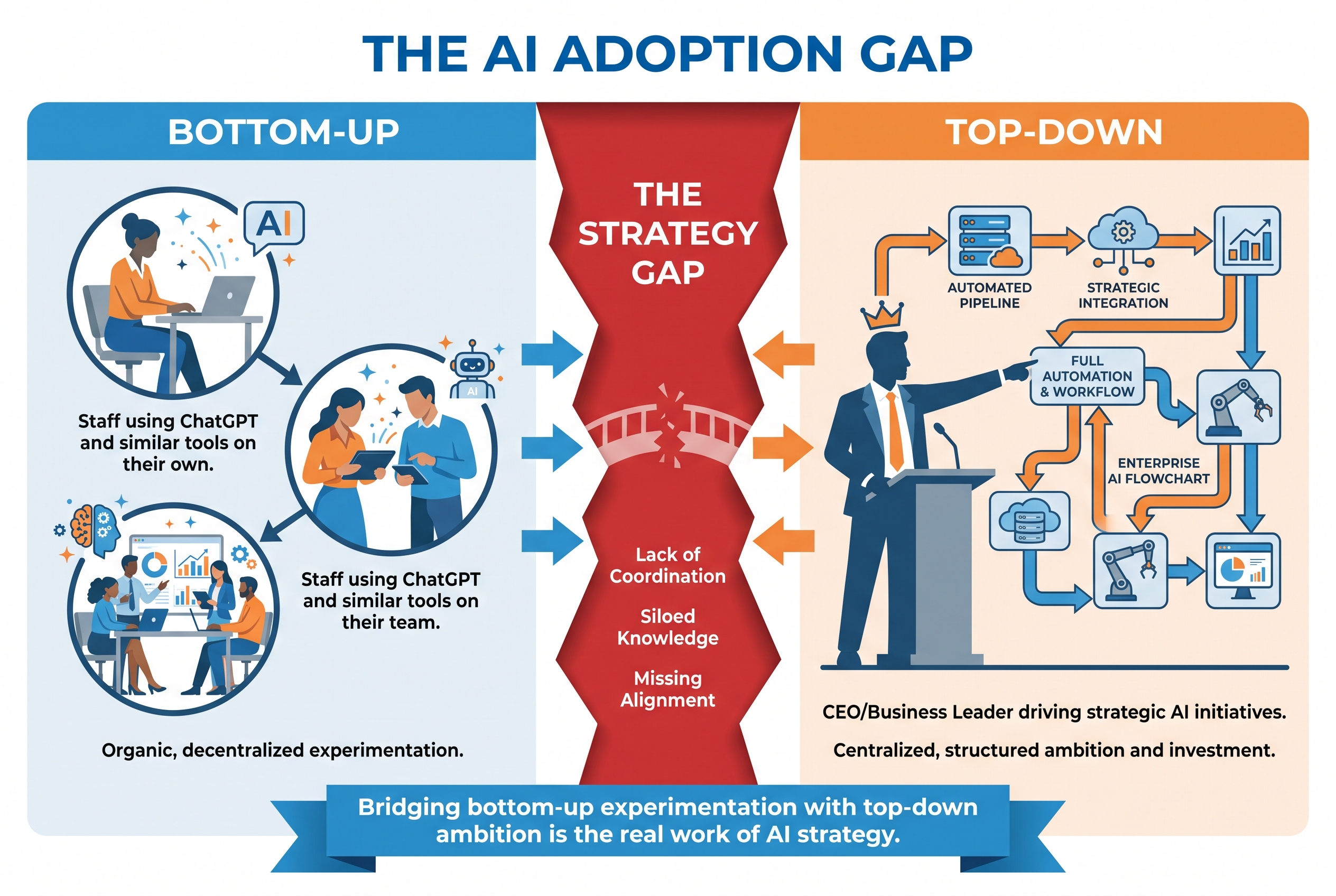
Answer capsule: Most Australian businesses are seeing AI adoption start from the bottom up -- employees using ChatGPT and other tools on their own initiative without formal policy or governance. Meanwhile, leadership imagines enterprise-wide automation without understanding the practical steps between. Bridging this gap is the real work of AI strategy.
The first thing I ask in any discovery call is how the AI conversation started within the organisation. The answer tells you almost everything about where to begin.
In this case, it was a classic bottom-up scenario.
"We have got the bottom end starting to use AI themselves. They are just like, 'Well, I am going to sign in and start using it.' Without asking. But we also do not have an active policy at the moment anyway."
Employees were already using AI tools -- mostly for writing emails, polishing documents, generating images. Nothing structured, nothing governed. Just people finding ways to save time.
Meanwhile, the CEO -- a founder who started the company 35 years ago and has always been about doing things better and faster -- was starting to hear about AI too. But his ideas were on a completely different scale:
"His idea would be: 'We just get our last 10 projects, put in the plans, the costs, the FF&E look and feel concepts -- and it is going to spit it out.'"
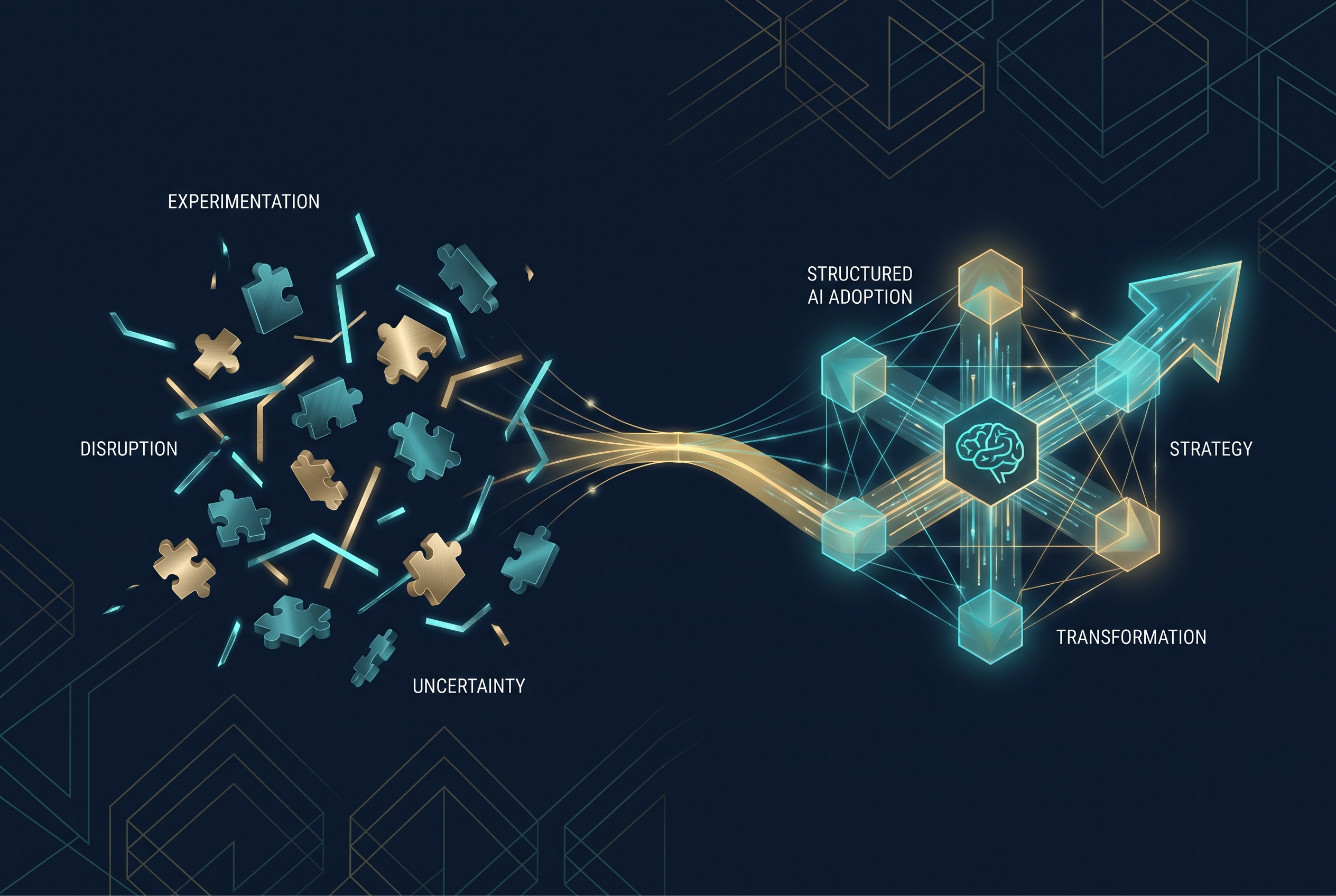
This gap -- between "help me write this email" and "automate our entire design-to-estimation pipeline" -- is where the real work happens. And it is exactly why I now talk about AI adoption in two distinct buckets.
What Are the Two Buckets of AI Adoption?
Answer capsule: There are only two ways to get meaningful leverage from AI: training your people to train AI with custom skills, or building dedicated AI agents that automate specific business processes. Everything else is productivity theatre that delivers marginal gains at best.
After doing this work across multiple organisations -- from construction to professional services -- I have found there are really only two ways to get meaningful leverage from AI. Everything else is just productivity theatre.
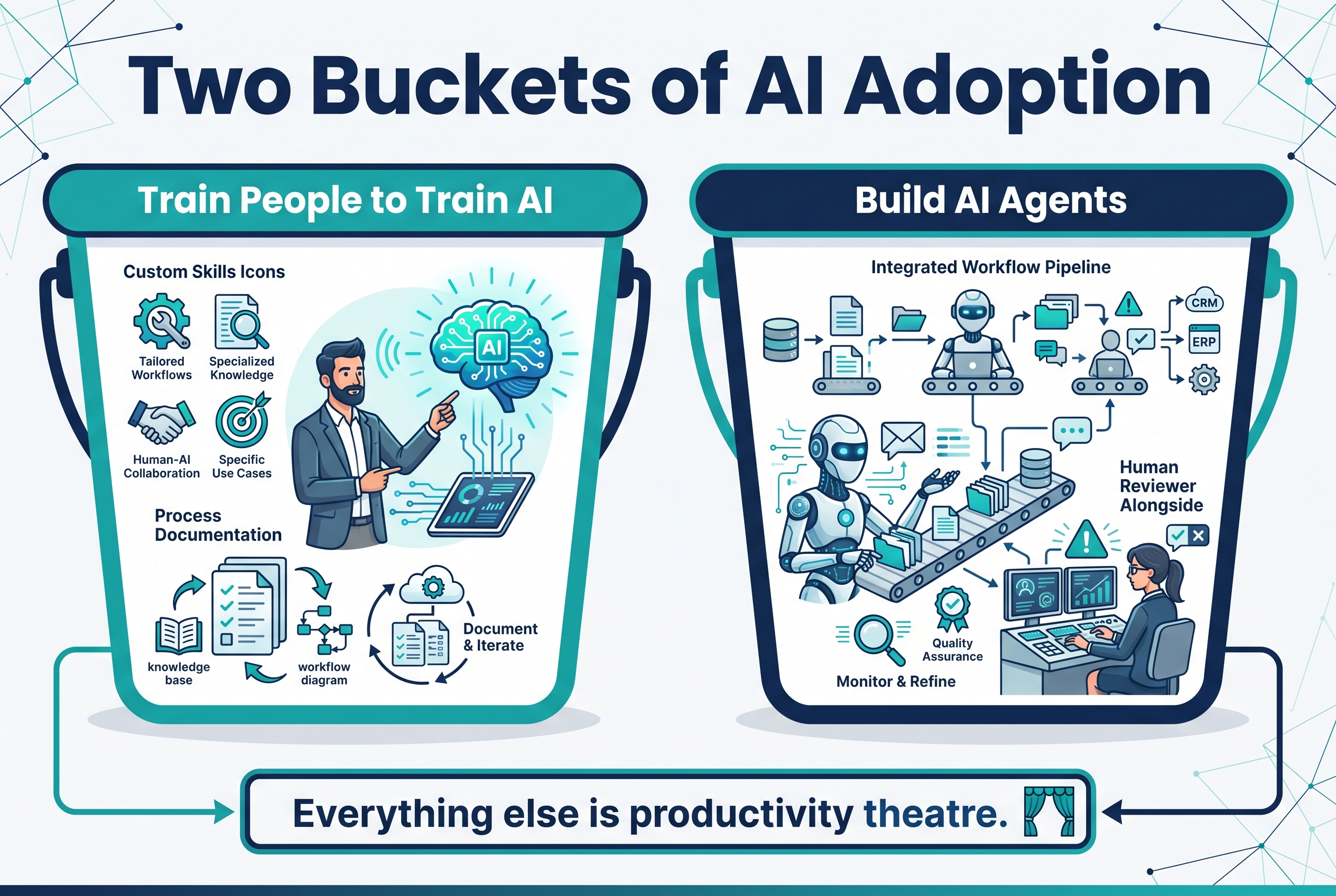
Bucket 1: Training Your People to Train AI
Most staff use AI like a calculator. You type in a question, you get an answer. Maybe you ask it to rewrite something. But the real power comes when you stop treating AI as a question-answer machine and start treating it as something you can train -- like an apprentice who can learn your specific processes.
"Train your staff to actually train AI and give your AI actual real-world skills. These skills could be bits of your process -- but it is almost like custom training your AI to do parts of their job."
A Microsoft report from a couple of months back found that staff who properly leverage AI are not doing less work -- they are doing more capable work. Productivity goes up, but so does responsibility. The ceiling moves.
I have seen individual contributors build custom skills that produce exact outputs they need -- plans, frameworks, analyses -- that no one else in the team does. That is leverage that scales.
The challenge? Not everyone has the mindset to apply this to their own role. Some people will just keep using it for emails and never discover the magic. That is when you move to Bucket 2.
Bucket 2: Building AI Agents for Your Specific Processes
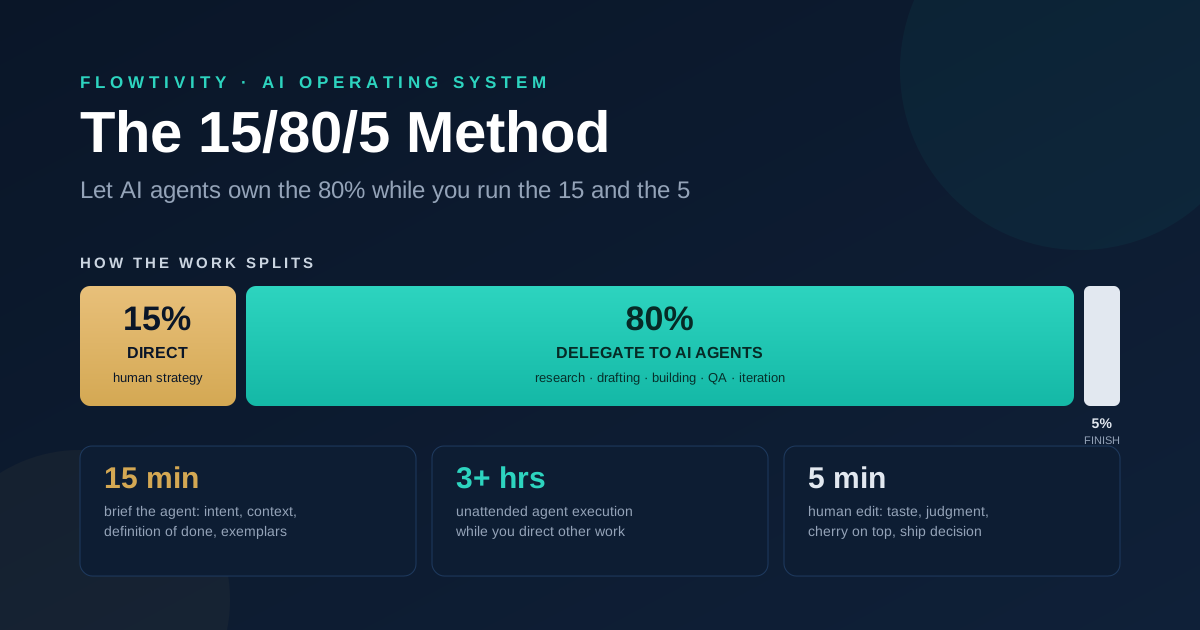
This is where I spend most of my time. An AI agent is essentially a digital employee you can train on a specific process. You give it context about what its job function is, how it needs to execute, and you embed it into your workflow -- either alongside a human reviewer or running autonomously in the background.
The difference from Bucket 1 is that the staff do not build the agent. They just tell me what their process is. I build it. They test it. We iterate.
"It is giving your organisation more employees, essentially, for very minimal marginal costs. Hiring takes eight to nine months to train someone. But with an AI agent, every time it runs, it gets smarter."
A real example: I built a quote review agent for a construction client. They were processing around 200 quotes a month -- with different pricing rules, client-specific fixed costs, spreadsheets from multiple sources. The agent did not replace the estimator. It reviewed every quote before a human touched it, flagging potential losses and prioritising which ones needed attention.
The result was not layoffs. It was better decisions, faster.
What Is the Org Chart Exercise and Why Should You Do It?
Answer capsule: Before buying any AI software or building agents, map your organisational chart by person, system, output, and definition of done. Then overlay where AI agents could slot in. This reveals your real AI adoption plan without the tech jargon.
One thing I recommended to this team -- and I would recommend it to anyone reading this -- is to do one specific exercise before buying any software or building any agents.
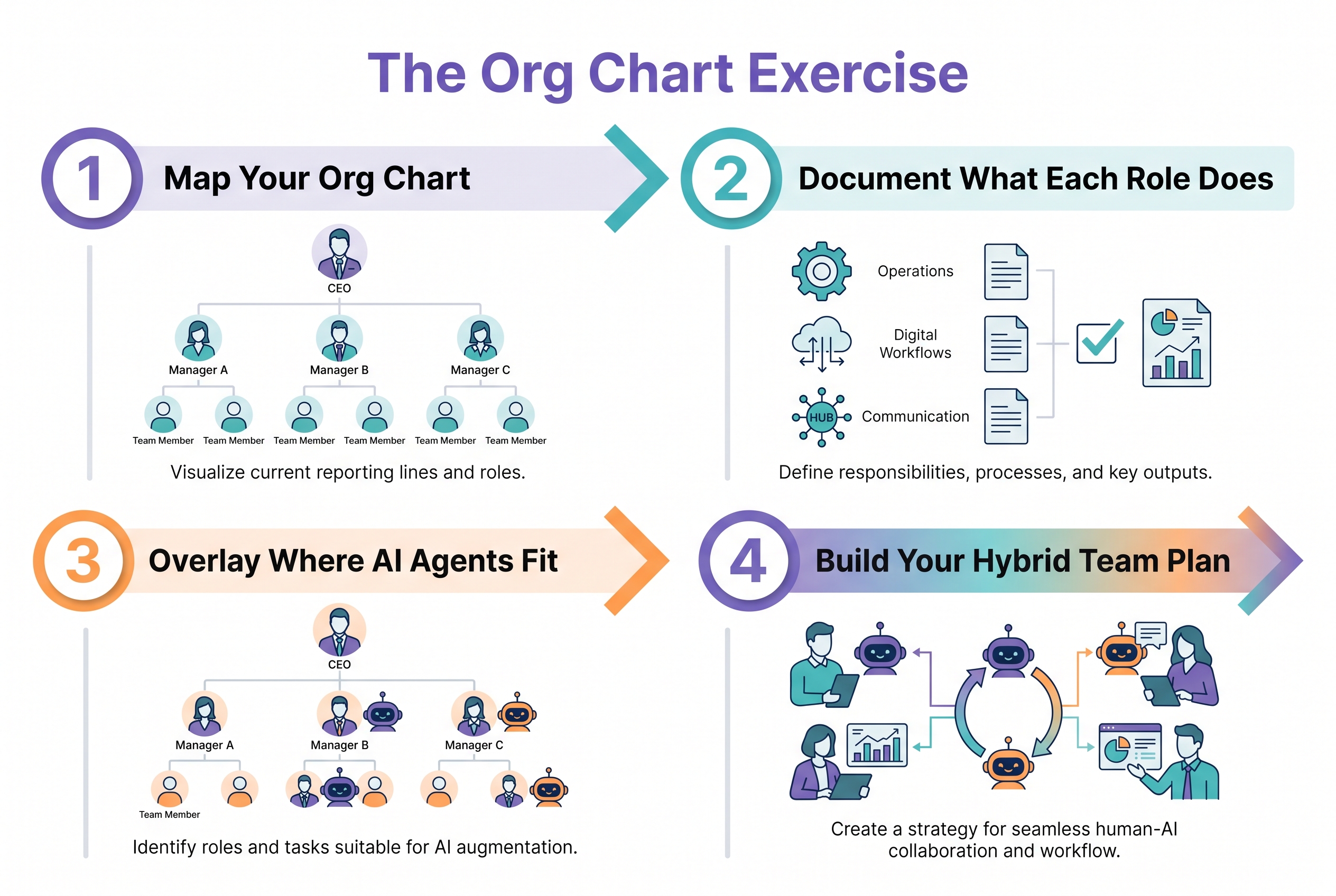
Get your organisational chart. For every person in every division, map out:
- What systems do they use?
- What outputs do they produce?
- What does "done" look like for their function?
Then on that same chart, add a layer: "Imagine we could add AI agents into these teams. Where would they go?"
"You get a bit of a plan. This is what our organisation looks like today with no AI agents. And moving forward, we hope to expect that we have maybe 10 new agents across four different departments, onboarded, trained, integrated."
This is not a technical exercise. It is a functional one. You are not installing software -- you are designing how your teams will work with digital colleagues.
For more on how agents fit into modern teams, read our comparison of AI agent management platforms.
Will AI Take My Job?
Answer capsule: No, but your job will change. AI is exceptionally good at high-volume data analysis, rule-heavy processes, and repetitive admin. It is bad at judgment calls in ambiguous situations and taking responsibility. Human reviewers remain essential for accountability and context.
It came up in this conversation. It comes up in every conversation. The honest answer is: no, but your job will change.
"Human judgment is still vital to every process. You still need human reviewers in the job. We are not going to be doing grunt work anymore. We will move to higher levels of discussion -- engaging with customers, creating ideas, reviewing the outputs of our AI agents."
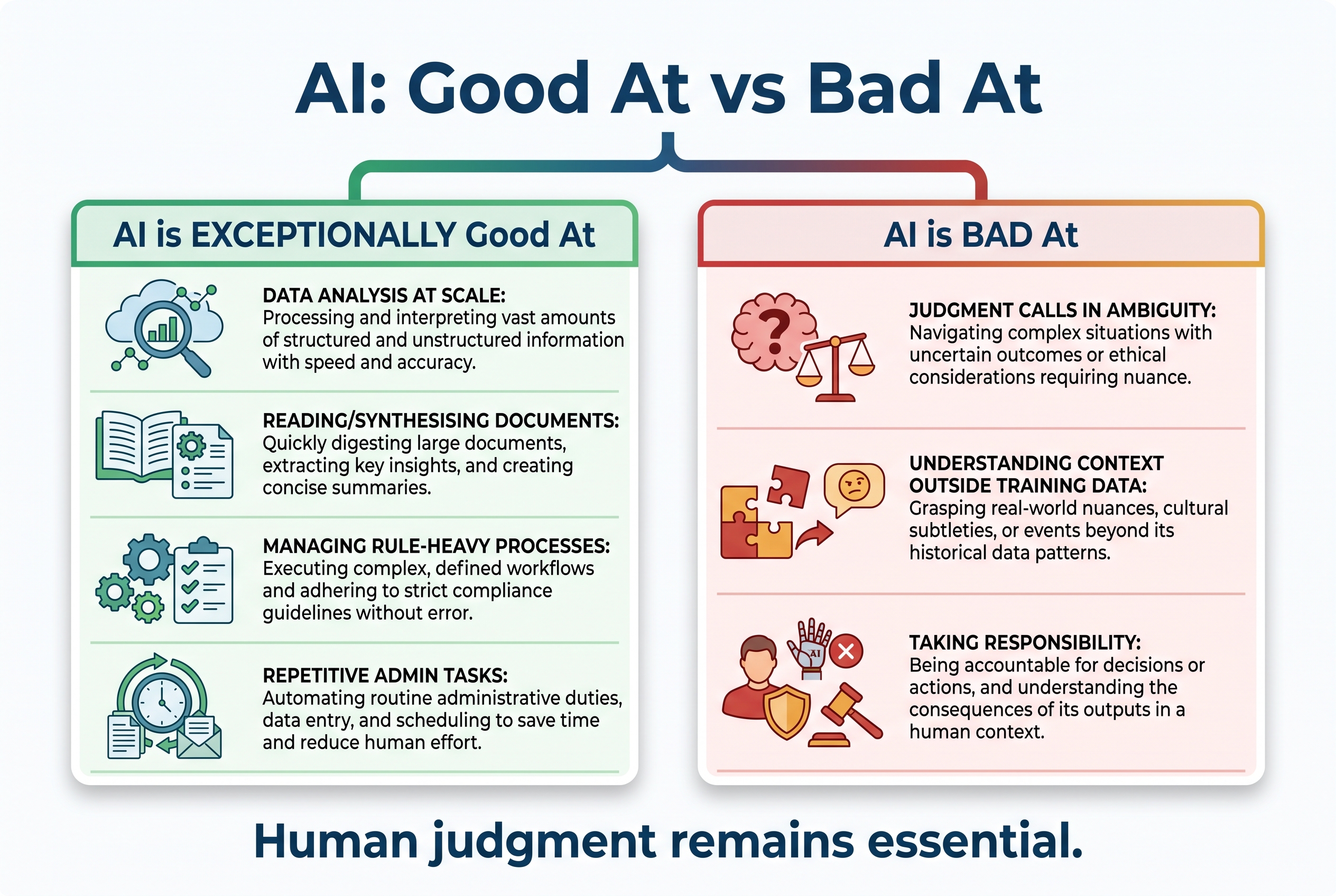
AI is exceptionally good at:
- Data analysis at scale
- Reading and synthesising hundreds of pages in seconds
- Managing high-volume, rule-heavy processes
- Repetitive admin that nobody went to university for
AI is bad at:
- Judgment calls in ambiguous situations
- Understanding context that lives outside its training data
- Taking responsibility when something goes wrong (the company is still liable)
So yes, parts of jobs will be automated. The parts people hate. The parts that burn them out. But someone still needs to be accountable for the outcome.
"It does the parts of people's jobs that they hate really well. All the admin side, the repetitive stuff -- none of us went to university to do data entry."
Which AI Platform Should You Choose: Copilot, Claude, or ChatGPT?
Answer capsule: If ranking today, Claude leads for reasoning and agent-like capabilities, ChatGPT is a fast follower, and Copilot makes sense if you are already deep in Microsoft 365. But all three are converging within the next year. Do not bet the farm on one -- pick the right tool for your specific use case.
This company already had Microsoft 365 with Copilot licences. The security concern was real -- they do some government work, and data sovereignty matters. But here is the truth I shared with them:
"If you are trying to rank them today: Claude is number one, ChatGPT is a fast follower. But they are all going to get to the same end state within the next year."
Do not bet the farm on one horse. Pick the horse that is right for your race and start riding.
Also consider: some SaaS platforms (like Monday.com, which they used) are building AI agents into their products. Those agents will be really smart within that platform's context. But they cannot see your Outlook data, your site supervisor's reports, or your historical project costs. That is where a cross-functional agent, built intentionally, creates disproportionate value.
If you are evaluating platforms, see our OpenClaw vs Paperclip comparison for a deeper breakdown of agent orchestration frameworks.
How Do You Pick the Right First AI Project?
Answer capsule: Do not start with something easy. Pick your hardest, most painful business problem -- the one that burns money or time. AI is capable enough to solve hard challenges, and nothing builds momentum like solving a real, painful problem first.
If there is one takeaway from this conversation, it is this: do not start with something easy.
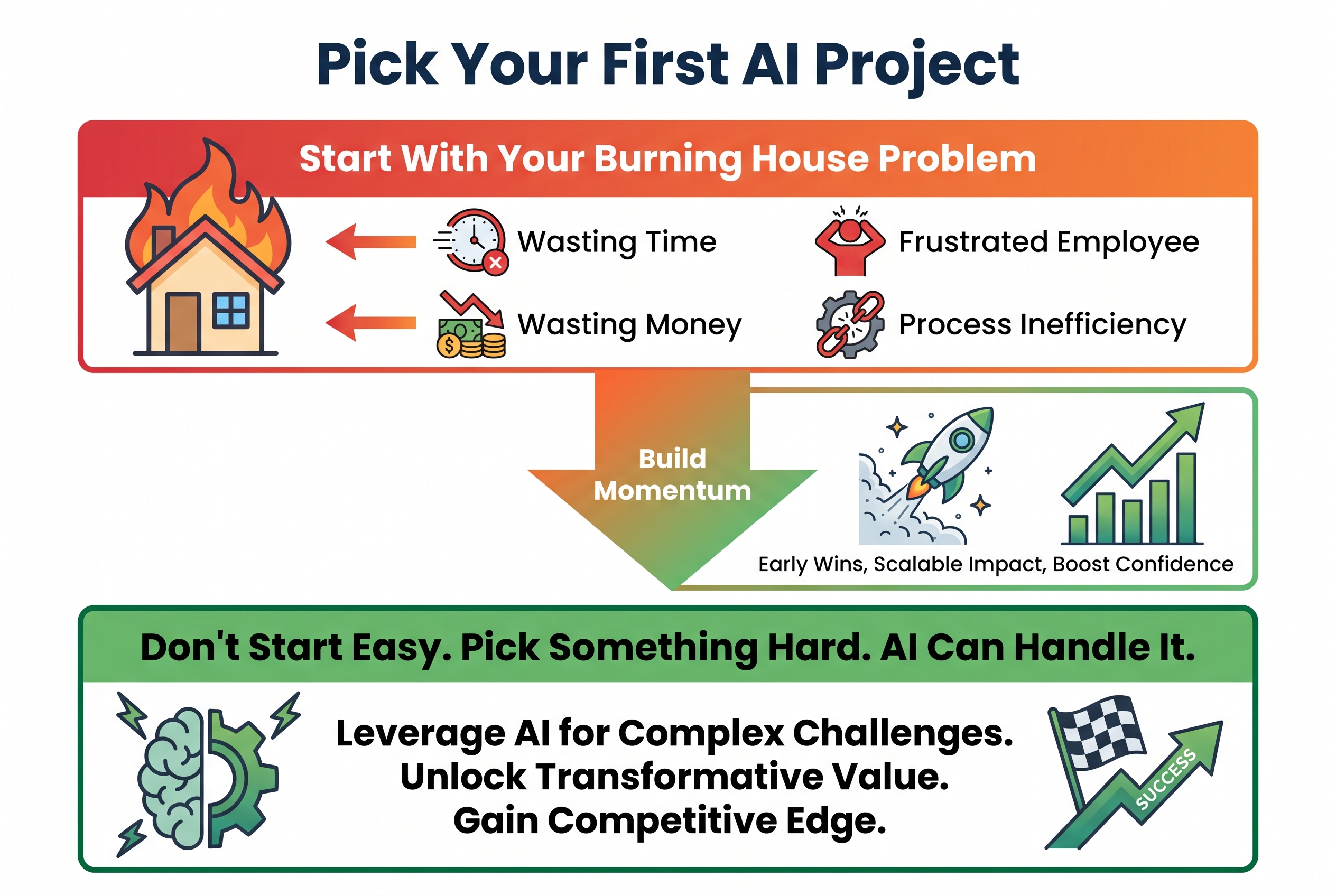
"Pick something that is challenging and hard. Because AI is very capable. If you solve a hard challenge, it delivers a lot of benefit. And once you deliver that and people see what is possible, they will be asking: 'What else can it do?'"
Start with your burning house problem. For this company, it might be the manufacturing quoting process that takes an experienced estimator hours to do manually. For another company, it might be reviewing 200 quotes a month and losing margin on half of them.
Whatever it is -- pick it. Solve it. Use the momentum. Training can always come later. AI champions can be identified after the first win. The org chart can be refined as you go. But nothing happens until you start.
If you are having conversations like this inside your organisation and do not know where to begin -- this is exactly what I do. Reach out. Let us map it out together.
Frequently Asked Questions
How do most Australian companies start using AI? Most start from the bottom up -- individual employees begin using ChatGPT, Claude, or Copilot on their own initiative without formal governance. Leadership hears about AI and imagines enterprise-scale automation, but there is rarely a bridge between the two. A structured discovery call and org chart exercise can close that gap.
What is the difference between training AI and building AI agents? Training AI means teaching your staff to customise existing tools for their specific workflows -- like creating custom skills or prompts. Building AI agents means creating dedicated digital employees that run specific business processes autonomously or alongside human reviewers. Training scales through people; agents scale through automation.
Will AI agents replace human workers? Not in the way most people fear. AI agents take over repetitive, high-volume tasks -- data entry, quote review, document analysis -- freeing humans to focus on judgment, customer relationships, and creative problem-solving. The companies that succeed are not the ones that replace people, but the ones that augment them.
Should I use Copilot, Claude, or ChatGPT for my business? It depends on your existing stack and use case. Copilot integrates natively with Microsoft 365. Claude currently leads on reasoning quality and agent-like capabilities. ChatGPT is a strong all-rounder. All three are converging in capability. The real differentiator is how you deploy them -- not which one you pick.
What is the first step in creating an AI adoption plan? Map your organisational chart. Document every role, every system they use, every output they produce, and what "done" looks like. Then overlay where AI agents or trained AI tools could fit. This gives you a concrete, non-technical plan that leadership can understand and act on.
One email a month, no noise
Practical AI notes for Australian businesses. Unsubscribe anytime.