
On this page
- What Is the Theory of Constraints?
- Why Most AI Agent Deployments Fail
- The Five-Step Method for Deploying AI Agents
- Step 1: Define Throughput Correctly
- Step 2: Find the Constraint
- Step 3: Exploit the Constraint Before Spending a Dollar
- Step 4: Synchronize Everything Else to the Constraint
- Step 5: Elevate, Then Repeat
- Which AI Agent Fits Which Constraint?
- Anti-Patterns That Kill Agent Programs
- A 90-Day Rollout Plan
- What This Looks Like in Practice
- Frequently Asked Questions
Last Updated: August 27, 2026
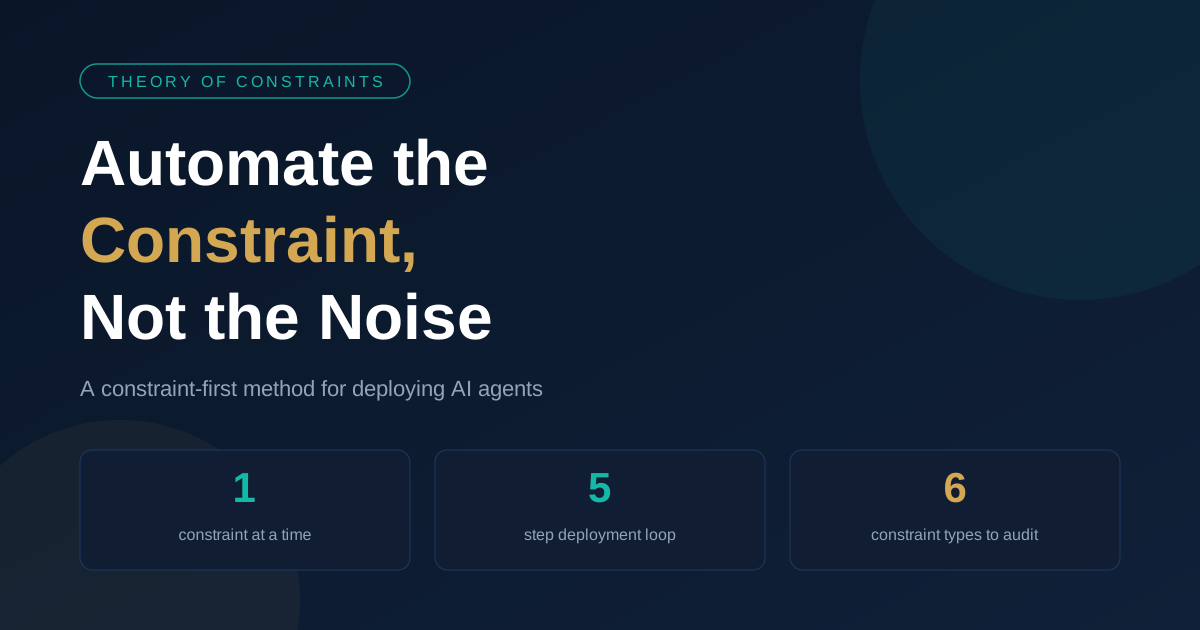
Deploy your first AI agent against the single biggest bottleneck in your business, not wherever automation feels easiest. That is the entire method. The Theory of Constraints, from Eliyahu Goldratt's 1984 book The Goal, says a business produces outcomes at the rate of its one weakest link. AI agents are capacity multipliers, so pointing them at the constraint multiplies the one thing that sets your revenue, while pointing them anywhere else multiplies noise and cost. In this guide you get the five-step loop, the six constraint types to audit, an agent deployment matrix, and a 90-day rollout plan.
What Is the Theory of Constraints?
The Theory of Constraints holds that any system, a factory, a plumbing company, a consultancy, generates outcomes at the rate of its single slowest step. Focus on increasing throughput rather than cutting cost, treat everything else as noise, and grow by fixing one limiting step at a time. Goldratt's book The Goal has sold millions of copies since 1984 and remains standard reading in manufacturing, yet according to a widely shared 2026 explainer video on the topic, the idea still gets little attention from the wider business world.
The concept got fresh attention through Elon Musk. Marc Andreessen, co-founder of Andreessen Horowitz, has called Musk the most effective entrepreneur he has ever met, and a major reason is that Musk spends far more time than other founders on what he calls the limiting step. "He obsesses over finding the limiting step, fixing it, and then finding the next one, across all of his companies," the explainer notes. Musk's reputation as a micromanager is really constraint hunting: he goes into detail only where detail sets throughput.
"A business is only as good as its weakest link." This is the core of Goldratt's Theory of Constraints, and the reason most AI deployments disappoint: they strengthen links that were never the weak one.
Why Most AI Agent Deployments Fail
Most AI agent deployments fail because they automate activity instead of throughput. Teams point agents at whatever is easiest to automate or loudest to complain about, then measure messages sent, posts published, or tasks closed. None of those numbers is throughput. The result is activity theater: dashboards improve, revenue does not, and the real bottleneck keeps capping the business while it also absorbs a new flood of half-finished agent output to review.
There is a second, subtler failure: agents deployed upstream of the bottleneck. If your delivery team can complete 10 jobs a week, a marketing agent that generates 50 bookings does not grow the business. It grows the queue. Goldratt's rule applies to automation exactly as it applies to raw material: do not buy 100 units of input for a machine that can process 50. AI makes this trap unusually easy to fall into because generating more volume is precisely what agents are good at.
The Five-Step Method for Deploying AI Agents
The method is a loop: define throughput, find the constraint, exploit it, synchronize everything else to it, elevate it, then repeat with the next constraint. Automation enters at steps 3, 4, and 5 in that order, never at step 1 for its own sake. Here is each step as an operating instruction.
Step 1: Define Throughput Correctly
Throughput is the rate at which your system generates the outcome customers pay for. Not activity, not output volume, not capacity. A trades business might define it as jobs profitably completed per week. An allied health practice: billable patient hours delivered. A consultancy: signed and delivered engagements per quarter. The test is simple: if this number doubled with the same headcount, would revenue clearly rise? If not, you have measured activity, not throughput.
Step 2: Find the Constraint
Audit the six constraint types. Market: insufficient demand, the pipeline is thin. Sales: leads arrive but do not convert. Delivery: sales outpace capacity and jobs queue up. Decisions: work waits on the owner or partners to approve. Capital: cash tied up, cannot fund the next job. Talent: roles stay open and key people are overloaded. The trick, as the explainer puts it, is to find the constraint that is throttling throughput, not just the thing that is annoying you. Run a one-week diagnostic: map the value stream, find where work piles up, and ask every team what they are waiting on. The answer that repeats is your constraint.
Step 3: Exploit the Constraint Before Spending a Dollar
This is the subtle move. The instinct when you find a bottleneck is to throw money at it. Goldratt's instruction is the opposite: reorganize the work to get the absolute maximum output from the constraint using resources you already have. Keep it never idle. Strip low-value work off it, because every hour of admin or data entry sitting on the constraint is stolen throughput. Feed it better inputs. Maximize its yield, defined as output, not capacity. This is where agents earn their keep first: not doing the constraint's job, but taking work off it and guarding its inputs.
Step 4: Synchronize Everything Else to the Constraint
Subordinate the rest of the system to the bottleneck's capacity, even when it feels like throttling growth. If the machine can make 50 widgets, do not buy 100 units of raw material and watch it pile up. If you can handle 10 quality sales calls per week, do not run paid ads producing 50 bookings. Agents are perfect synchronizers here: use them to qualify, filter, schedule, and pace the flow, so the constraint always receives exactly enough ready work and never a flood. A lead-qualifying agent that passes only sales-ready leads into your 10-call capacity is not throttling growth, it is protecting throughput.
Step 5: Elevate, Then Repeat
Only after exploitation is maxed do you add capacity, and this is where agents become the capacity. Automate the constraint's repetitive components so humans keep only judgment work. Duplicate the constraint's function with parallel agents plus human review. The moment throughput rises, the constraint migrates somewhere else, so go back to step 2 and find it. Musk's own build sequence rhymes with this: question the requirement, delete, simplify, accelerate, automate. Automation is deliberately last.
Which AI Agent Fits Which Constraint?
Match the agent pattern to the constraint type, and run one constraint, one agent focus, at a time. This matrix maps the six constraint types from the method to the agent deployment that attacks each, plus the metric that tells you whether it is working.
| Constraint | Symptom | AI agent deployment | Metric to watch |
|---|---|---|---|
| Market | Not enough demand | Content and SEO agents publishing daily drafts from real customer language | Qualified inbound leads per week |
| Sales | Leads not converting | Research, enrichment, and follow-up agents on every single lead | Lead to call conversion rate |
| Delivery | Cannot fulfill the work sold | Ops agents for scheduling, quotes, job documentation, status updates | Jobs delivered per week, cycle time |
| Decisions | Everything waits on the owner | Briefing and reporting agents that pre-digest options into one-pagers | Decision latency in days |
| Capital | Cash tied up in receivables | Invoicing and collections agents chasing faster payment | Days sales outstanding |
| Talent | Not enough skilled hands | Agent apprentices doing first-pass work with human review | Output per person, ramp time |
Anti-Patterns That Kill Agent Programs
Watch for five recurring failure modes once agents enter the building. Each one is a misapplication of the method, and each is avoidable with the discipline of one constraint at a time.
- Activity theater. Measuring posts, sends, and tasks instead of throughput of the current constraint. If a metric does not move the constraint, it is noise.
- Agent sprawl. Twelve agents across twelve departments when the constraint is one person in one seat. Multiply the link that matters.
- Automating waste. Using agents to do faster what should not be done at all. Delete first, automate last.
- Flooding the bottleneck. Five-x lead generation while delivery drowns. Synchronize before you amplify.
- Optimizing the loudest complaint. The constraint is where work piles up, not where the squeakiest wheel sits.
A 90-Day Rollout Plan
Ten days to find the constraint, twenty to exploit and synchronize, thirty to measure, thirty to elevate. The plan assumes one constraint in focus and one agent pattern deployed against it at a time.
- Days 1 to 10: Define the throughput metric as one outcome-based number. Map the value stream and run the waiting-on survey. Name the constraint and its weekly capacity, for example "the GM can close 4 jobs per week."
- Days 11 to 30: List every task sitting on the constraint that is not constraint work, typically 30 to 50 percent of its week. Deploy one agent pattern to strip that work. Gate upstream volume to constraint capacity.
- Days 31 to 60: Compare throughput before and after. No movement means the wrong constraint was picked, so return to step 2. Kill or fix any agent that creates review burden instead of removing work.
- Days 61 to 90: Elevate: automate the constraint's repetitive components and add parallel capacity with human review. Re-run the diagnostic because the constraint has moved, and plan the next agent there.
What This Looks Like in Practice
We run this loop at Flowtivity, and it is how we build for clients. Our own operation is agent-first: a research agent enriches every outbound lead before any human touches it, a voice agent answers inbound calls with full lead context, and our tender monitor classifies government tender feeds daily. On the client side, discovery is constraint finding, the prototype we build before any pitch is exploit-phase proof, and the agents we deploy are the elevation step. In our pipeline work we have processed 273 tender-stage leads through this loop, and the pattern holds: the businesses that grow from AI are the ones that aimed it at one limiting step, not the ones that bought the most agents.
Frequently Asked Questions
Where should a business deploy AI agents first? Against the single biggest bottleneck, the step that limits how many outcomes you produce per week. That is where a capacity multiplier changes revenue.
What are the six constraint types? Market, sales, delivery, decisions, capital, and talent. One throttles throughput at a time, and it moves as you fix each.
How do I find my bottleneck? Look for where work piles up in the value stream and ask every team what they are waiting on. The repeated answer is the constraint.
Why do AI projects fail? They automate activity instead of throughput, and they flood the bottleneck instead of synchronizing to it.
What's actually useful in AI, every Friday
We follow everything happening in AI and send what's worth your time: new models, AI agents, and how to put them to work. One email a week, unsubscribe anytime.


