

On this page
- What Is Xiaomi MiMo-V2.6?
- Why Can a 309B Model Be So Cheap to Run?
- How Does MiMo-V2.6-Pro Compare With Claude Opus 5 and GPT-5.6 Sol?
- How Was MiMo-V2.6 Trained?
- What Does MiMo-V2.6 Cost to Run?
- Why the MIT License Matters for Your Business
- Should Your Business Use MiMo-V2.6?
- Frequently Asked Questions About Xiaomi MiMo-V2.6
Last Updated: 22 September 2026
Xiaomi's MiMo-V2.6 series, released on 22 September 2026, is the strongest open-weights model family available today, and it costs roughly a twentieth of what the big closed labs charge for comparable performance. According to Artificial Analysis, an independent benchmarking service, MiMo-V2.6-Pro scores 46 on the Artificial Analysis Intelligence Index, the highest score ever recorded by an openly available model and one point behind OpenAI's GPT-5.6 Sol at 47. It reaches that score at about US$0.13 per task, placing it on the intelligence-versus-cost Pareto frontier. In plain terms, no model on the market delivers more intelligence per dollar.
The practical meaning for Australian businesses is simple. Agentic automation, the category covering tool use, terminal work, computer use and multi-step workflow execution, is exactly where MiMo-V2.6-Pro trades wins with models costing many times more. According to Xiaomi's launch claims, at comparable intelligence the Pro model costs roughly one-twentieth to one-sixtieth of leading international models. In our client automation work at Flowtivity, agentic workloads like these are where the majority of real-world LLM spend sits.
What Is Xiaomi MiMo-V2.6?
MiMo-V2.6 is Xiaomi's latest open-weights model family, released on 22 September 2026 in three variants. MiMo-V2.6-Pro is the flagship with 1.02 trillion total parameters and 42 billion active per token. MiMo-V2.6-Flash is the efficiency model with 309 billion total parameters and 15 billion active per token. MiMo-V2.6-Pro-UltraSpeed is a latency-optimised build of the same checkpoint priced ten times higher. All three are natively omnimodal, accepting text, image, video and audio input, and they carry a 1,048,576-token context window with a 131,072-token maximum output, according to HokAI's model database.
The MiMo line has moved fast. MiMo-V2-Pro landed in March 2026 after a stealth debut as an anonymous model called Hunter Alpha on OpenRouter, and the V2.5 generation followed mid-year. According to OfficeChai, the MiMo team is led by Fuli Luo, a former DeepSeek researcher, and sits inside a Xiaomi AI program backed by a committed US$8.7 billion over three years. The structural backdrop matters too: Chinese labs now dominate the open-weights tier, and the share of tokens processed by US models on neutral routing platforms has fallen from roughly 70 percent to 30 percent within a year, with Xiaomi among the ten most-used providers by volume.
Why Can a 309B Model Be So Cheap to Run?
MiMo-V2.6-Flash is a sparse mixture-of-experts (MoE) model. It stores knowledge across 309 billion parameters, but a router activates only about 15 billion per token, selecting a handful of specialists from a large pool. Inference cost scales with active parameters rather than total parameters, so you pay compute for 15 billion while retaining the knowledge of 309 billion. According to Xiaomi's documentation, a hybrid attention design interleaves aggressive 128-token sliding windows with full attention at a 5:1 ratio, which cuts memory traffic on long sequences further still.
The Pro model takes the same approach at larger scale. According to HokAI, it spans 70 transformer layers (60 sliding-window and 10 global-attention) with a hidden size of 6,144, 384 routed experts with 8 active per token, and a five-layer speculative decoder for multi-token prediction. Artificial Analysis independently measured 129.7 output tokens per second and a 2.17-second time to first token on the standard endpoint, ranking it 13th of 39 general-availability models for speed despite the trillion-parameter footprint.

How Does MiMo-V2.6-Pro Compare With Claude Opus 5 and GPT-5.6 Sol?
According to Artificial Analysis, MiMo-V2.6-Pro scores 46 on the Intelligence Index: sixth overall and first among open-weights models, against 51 for Claude Opus 5 and 47 for GPT-5.6 Sol. On agentic benchmarks it wins some outright. Its 53.1 on AutomationBench beats every closed rival in Xiaomi's comparison table, and its 89.9 on Terminal Bench 2.1 was the best score in the table. It ties Claude Opus 5 on Agents' Last Exam at 31.6. It still trails on the hardest terminal work, competitive programming and offensive security.
| Benchmark | MiMo-V2.6-Pro | Claude Opus 5 | GPT-5.6 Sol |
|---|---|---|---|
| AA Intelligence Index | 46 | 51 | 47 |
| DeepSWE v1.1 (agentic coding) | 71.9 | 74.0 | 73.0 |
| AutomationBench v1.0.6 | 53.1 | 50.3 | 45.8 |
| Terminal Bench 2.1 | 89.9 | n/p | n/p |
| Agents' Last Exam | 31.6 | 31.6 | n/p |
| GDPval-AA 2.1 | 1673 | 1708 | n/p |
| OSWorld-Verified (computer use) | 82.0 | n/p | n/p |
| Terminal Bench 4.0 | 34.9 | 49.0 | n/p |
| ProgramBench (competitive coding) | 26.5 | 37.0 | n/p |
| ExploitBench (offensive security) | 47.9 | n/p | 78.5 |
Scores from Xiaomi's MiMo-V2.6 technical report as reported by OfficeChai and Artificial Analysis, September 2026. n/p means not published in the sources we reviewed. Bold marks MiMo wins.
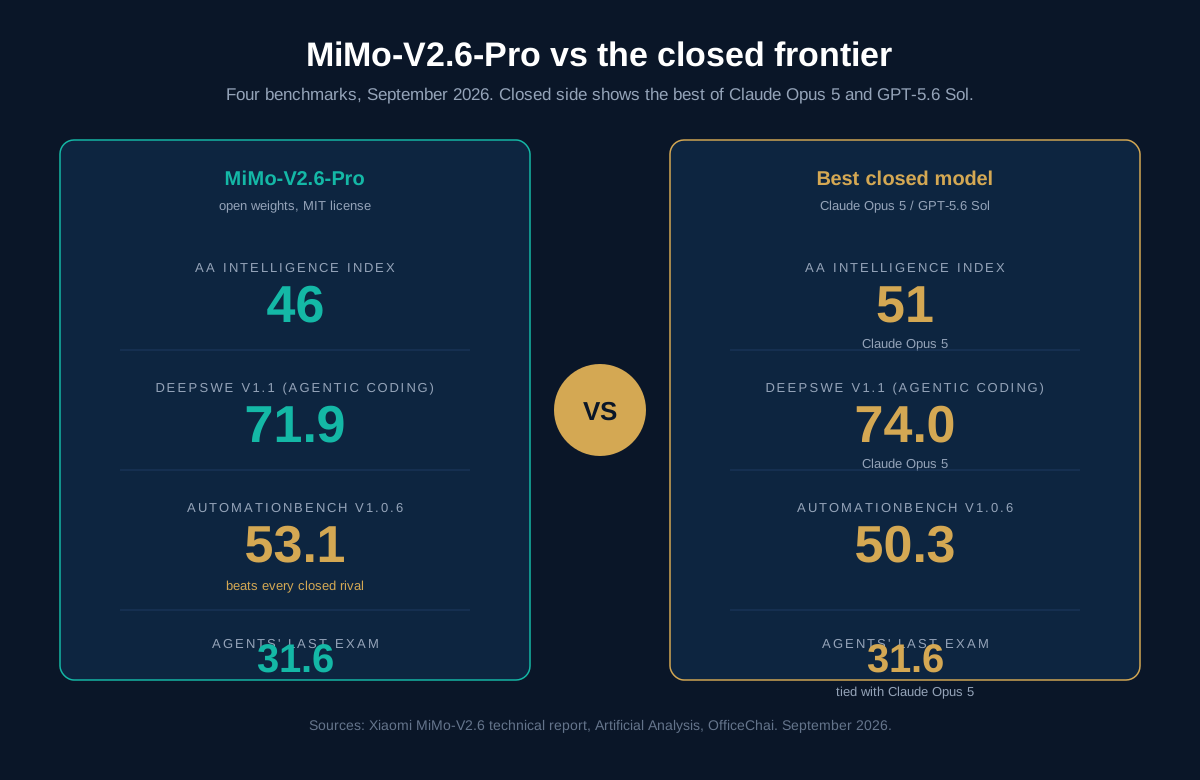
The honest summary is that MiMo-V2.6-Pro is a frontier-class agentic model that concedes ground on the hardest reasoning and security tasks. It posts 94.0 on CyberGym and 82.0 on OSWorld-Verified computer use, and its 72.3 on MiMo Visual Coding beats Claude Opus 5's 70.0. But on Terminal Bench 4.0 it scores 34.9 against Opus 5's 49.0, on ProgramBench 26.5 against 37.0, and on ExploitBench 47.9 against GPT-5.6 Sol's 78.5. "MiMo-V2.6-Pro performs on par with Claude Opus 5 and GPT-5.6 Sol across most agent benchmarks," Xiaomi stated at launch, a claim the table largely supports with three clear exceptions.
How Was MiMo-V2.6 Trained?
Xiaomi describes MiMo-V2.6 as a step on the RSI (recursive self-improvement) path: scaling reinforcement-learning compute on verifiable, complex tasks so the model keeps expanding its capability frontier through exploration and feedback. The company's "Aligned RL" recipe pairs large-scale RL with environment hardening, adversarial screening and verifier cross-checks against reward hacking, plus a self-correction step where the model rewrites its own misaligned reasoning. Unusually for a frontier lab, Xiaomi livestreamed the RL training run publicly, and the visible spend counter passed US$3 million across the Pro and Flash checkpoints two days before release.
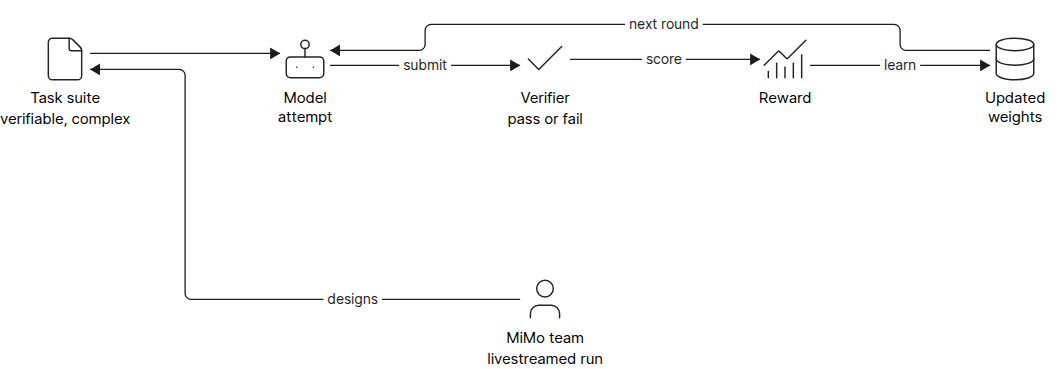
"This marks a key step in our exploration of the RSI path: scaling RL compute on verifiable, complex tasks, so the model can continuously expand its capability frontier through exploration and feedback," the Xiaomi MiMo team wrote in the launch announcement. Alongside the weights, Xiaomi published the technical report, the RL environments and the training code, which is a deeper release than most open-weights labs offer.
What Does MiMo-V2.6 Cost to Run?
Both Pro and Flash cost US$0.435 per million input tokens and US$0.87 per million output tokens, held flat from the V2.5 generation. Cached input is discounted 99 percent to roughly US$0.0036 per million tokens. According to Artificial Analysis that works out to about US$0.13 per intelligence task, which is what places the model on the cost-versus-intelligence Pareto frontier. The UltraSpeed variant costs ten times more (US$4.35 in, US$8.70 out) in exchange for substantially faster generation.
According to HokAI's job-costing estimates, real workloads price out like this: summarising a 20-page PDF costs about US$0.014, a single support reply about US$0.0011, and one full coding agent run about US$0.104. HokAI's blended price calculation puts MiMo-V2.6-Pro at US$0.544 per million tokens against a peer median of US$1.71, making it cheaper than 73 percent of the 63 general-availability models with published pricing.
Why the MIT License Matters for Your Business
MiMo-V2.6 ships under the MIT license, which permits commercial use, modification and redistribution without royalties. Weights are published on HuggingFace as safetensors in BF16, FP8 and INT8, so a self-hosting team can pick a precision that matches its hardware. For Australian businesses with data residency obligations, self-hosted inference means no prompt or output ever leaves infrastructure you control. The trade-off is operational: there is no vendor SLA on self-hosted weights, and no AWS Bedrock, Google Vertex or Azure marketplace listing has surfaced yet.

Should Your Business Use MiMo-V2.6?
Use it when your workloads are agentic, cost-sensitive and not blocked by compliance requirements: workflow automation, document processing, support triage and internal tooling are the sweet spot. Be more careful when audited safety documentation is non-negotiable. According to HokAI, Xiaomi has published no system card, no named red-teaming partners and no training-data cutoff, a thinner disclosure than OpenAI, Anthropic or Google DeepMind provide for their flagships. DeepSeek-V4 and Alibaba's Qwen3 are the closest open-weights alternatives to benchmark it against.
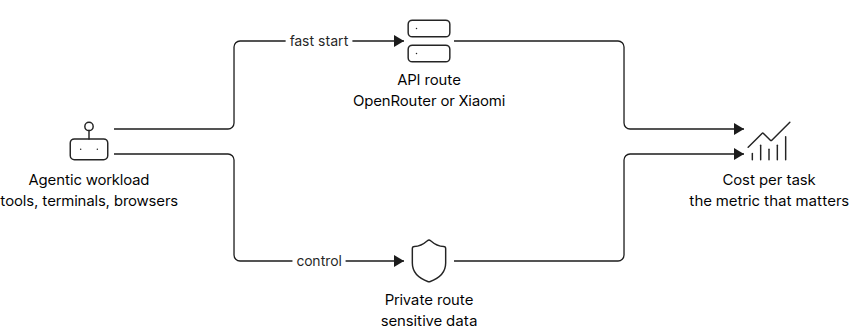
At Flowtivity, the previous-generation MiMo-V2-Flash is already configured in our agent stack for client automation work, which makes V2.6-Flash a straight upgrade test rather than a new integration. Our deployment rule for any model in this class: start on the API, measure cost per completed task rather than per token for two weeks, then decide whether volume justifies moving to self-hosted weights behind the client's own perimeter. At US$0.13 per task, the API tier stays economical far longer than most teams expect.
Frequently Asked Questions About Xiaomi MiMo-V2.6
Is Xiaomi MiMo-V2.6 open source?
Yes. The weights carry the MIT license and are published on HuggingFace (XiaomiMiMo/MiMo-V2.6-Pro-RL and MiMo-V2.6-Flash-RL). Xiaomi also published the technical report, the reinforcement learning environments and the training code. Commercial use, modification and redistribution are permitted without royalties.
How much does MiMo-V2.6 cost?
US$0.435 per million input tokens and US$0.87 per million output tokens for both Pro and Flash, with cached input at roughly US$0.0036 per million (99 percent off). That works out to about US$0.13 per Artificial Analysis intelligence task. The Pro-UltraSpeed variant costs ten times more for faster generation.
Is MiMo-V2.6-Pro as good as Claude Opus 5?
On most agent benchmarks it is on par or close. It ties Claude Opus 5 on Agents' Last Exam at 31.6, beats it on AutomationBench 53.1 to 50.3, and trails on DeepSWE 71.9 versus 74.0. On the hardest terminal benchmark, competitive programming and offensive security, Opus 5 and GPT-5.6 Sol hold a clear lead.
What is the difference between MiMo-V2.6-Pro and MiMo-V2.6-Flash?
Pro is the flagship at 1.02 trillion total parameters with 42 billion active per token. Flash is the efficiency variant at 309 billion total and 15 billion active. Both share the same pricing and context window, so Flash is the default when speed and cost matter more than maximum capability.
Can MiMo-V2.6 be self-hosted?
Yes. The MIT-licensed weights are available in BF16, FP8 and INT8 for self-hosting on your own GPU servers. Flash with 15 billion active parameters is the practical self-hosting target, while the 1.02 trillion parameter Pro assumes serious multi-GPU infrastructure. Hosted access runs through Xiaomi's console and OpenRouter.
Sources: Xiaomi MiMo-V2.6 release announcement and technical report, Artificial Analysis, OfficeChai and HokAI, accessed 22 September 2026.
One email a month, no noise
Practical AI notes for Australian businesses. Unsubscribe anytime.


