On this page
- What Is Perplexity Portable Computer?
- What Actually Runs on Your Machine
- Benchmark Results: How Good Is a Fully Local Agent?
- The Escalation Gate: Local-First, Not Local-Only
- Hardware Requirements and Pricing
- Why Model-Harness Co-Design Is the Real Story
- Who Should Care: The Australian Business Angle
- Our Take After Running a DGX Spark Ourselves
- Frequently Asked Questions
Last Updated: August 26, 2026
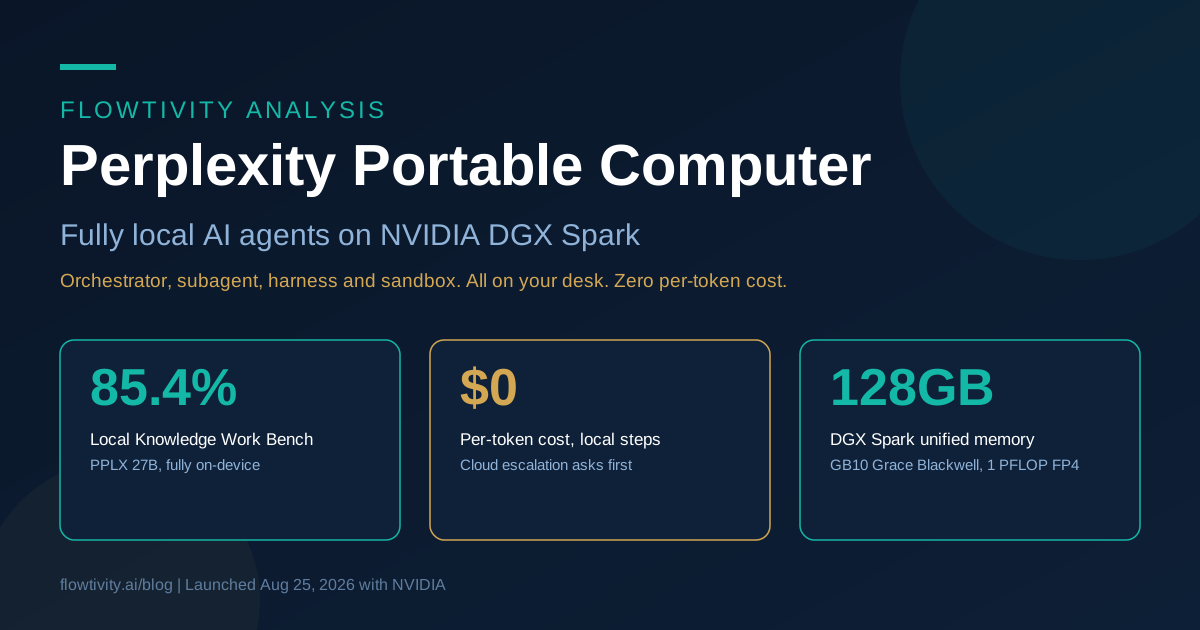
Perplexity Portable Computer, launched August 25, 2026 in partnership with NVIDIA, is a fully local build of the company's agentic Computer platform. The orchestrator LLM, subagent models, agent harness, inference engine, and security sandbox all run on hardware you own, starting with the NVIDIA DGX Spark desktop AI computer. Work completed locally carries zero per-token charges, every task starts on-device, and the agent asks permission before sending a single step to one of 15+ cloud models. On Perplexity's 53-task Local Knowledge Work Bench, the fully local setup scored 82.6% running Qwen 3.8 27B and 85.4% with PPLX 27B, versus 74.0% for the open-source Hermes harness running the identical model. The launch announcement passed 600,000 views on X within 24 hours.
What Is Perplexity Portable Computer?
Perplexity Portable Computer is the local-first edition of Perplexity Computer, the agentic platform the company launched in February 2026 to run multi-step knowledge work. The cloud version orchestrates frontier models such as Claude Opus 4.6 for research, analysis, and document production. Portable Computer moves that experience onto your own machine: DGX Spark first, plus Linux systems with any RTX GPU carrying 24GB of VRAM or more. It ships now for Perplexity Pro, Max, Enterprise Pro, and Enterprise Max subscribers on Linux, with Windows support arriving in September 2026. macOS is not on the roadmap.
According to VentureBeat, the launch was developed in close partnership with NVIDIA and targets users who want the model, the files, and the work itself to stay on one machine. The credit meter that normally ticks upward on cloud agents "is just parked at zero" during local runs, Perplexity's VP of engineering noted in a press demo that had the agent review a folder of sensitive 1099 tax documents and flag unnecessary fees without anything leaving the device.
"We've basically brought the exact same UI to a fully local app," said Nate, vice president of engineering for infrastructure and enterprise at Perplexity. "This incorporates the entirety of the agent harness and inference and everything needed to do work locally."
What Actually Runs on Your Machine
Portable Computer bundles a complete local AI stack into one install: the local model, inference engine, agent harness, tool sandbox, and app connectors ship together. At launch you select Qwen 3.8 27B (a 17.4GB download at 3-bit quantization, needing 32GB of RAM) or PPLX 27B, a variant Perplexity post-trained specifically for its own harness. NVIDIA's Nemotron 3.5 Lightning, an open 30B mixture-of-experts model, is listed as coming soon, and bring-your-own models are supported.
According to MarkTechPost, code and tool calls execute inside an OS-enforced sandbox that restricts processes, filesystem paths, and network access. If the sandbox is unavailable, tool execution is disabled rather than silently downgraded to unsafe defaults, a deliberate contrast with open-source harnesses that run commands with the user's full permissions. Connectors for Gmail, Outlook, Slack, GitHub, and Google Drive route through the local orchestrator, and installation on supported systems is a standard apt repository add.
Benchmark Results: How Good Is a Fully Local Agent?
On Perplexity's internal 53-task Local Knowledge Work Bench, which spans deep research, financial analysis, and document creation, Portable Computer running Qwen 3.8 27B on a DGX Spark scored 82.6%, versus 77.6% for the open-source Pi harness and 74.0% for Hermes running the identical model. Perplexity's post-trained PPLX 27B pushed the score to 85.4%. Perplexity says it plans to open-source the benchmark. These are vendor-run evaluations, so treat the absolute numbers with care, but the pattern is consistent across every test: a small local model inside a co-designed harness beats the same model inside general-purpose harnesses.
| Benchmark | Portable Computer (local) | Pi harness | Hermes |
|---|---|---|---|
| Local Knowledge Work Bench (53 tasks) | 82.6% (Qwen 3.8 27B), 85.4% (PPLX 27B) | 77.6% | 74.0% |
| BrowseComp (web research) | 66.7% | 50.2% | 43.9% |
| ParseBench-100 (document understanding) | 65.1% | 13.9% | 34.6% |
| Terminal Bench 2.1 (agentic coding) | 59.6% at ~$0 local | 73.0% at ~$0.415/run with cloud escalation | 82.4% at ~$0.65/run (Claude Opus 5 alone) |
On BrowseComp, Portable Computer hit 66.7% accuracy while using 51% less wall time and 70% fewer tokens than the Pi harness. On ParseBench-100 multimodal document understanding it scored 65.1% against Hermes at 34.6% and Pi at 13.9%. The most revealing number is the hybrid result on Terminal Bench 2.1: fully local scored 59.6% at effectively zero marginal cost, and escalating hard steps to a cloud adviser lifted it to 73.0% at roughly $0.415 per rollout, compared with 82.4% at about $0.65 for Claude Opus 5 alone. Escalation narrows the gap to frontier models without closing it.
The Escalation Gate: Local-First, Not Local-Only
Portable Computer is local-first, not local-only. When a step genuinely needs live web access or frontier reasoning, the orchestrator pauses and asks. Before any cloud call, the harness selects the relevant context, runs a PII classifier over it, and shows you exactly what would leave the machine. The approved step routes to one of more than 15 cloud models, and the remote model acts as an adviser that returns text guidance only. It never receives direct access to your local files, tools, or the ongoing conversation. This per-step permission model is the design decision that makes local agents viable for confidential business data.
Hardware Requirements and Pricing
The hardware gate is real but broader than expected. On the DGX Spark side you need the GB10 Grace Blackwell superchip with 128GB of coherent LPDDR5x unified memory and at least 1TB of storage. The Spark launched at $3,999 MSRP, and NVIDIA raised the price to $4,699 in February 2026 citing memory supply constraints, according to TechPowerUp. On the DIY side, any RTX GPU with 24GB of VRAM or more (roughly a GeForce RTX 3090 or newer) running DGX OS or Ubuntu on ARM or x64 qualifies. A Perplexity Pro subscription runs $20 per month and Max runs $200 per month, and only one DGX Spark is supported at launch, with clustering on the roadmap rather than shipped.
- DGX Spark path: GB10 superchip, 128GB unified memory, 1 PFLOP of FP4 AI compute, 20-core Arm CPU, handles models up to 200B parameters for inference
- RTX path: any NVIDIA RTX GPU with 24GB+ VRAM, DGX OS or Ubuntu, ARM or x64, standard apt install
- Subscription: Perplexity Pro, Max, Enterprise Pro, or Enterprise Max, Linux today, Windows in September 2026
Why Model-Harness Co-Design Is the Real Story
The deepest part of the launch is not the hardware, it is the research thesis. Perplexity published a paper alongside the launch arguing that effective local agents require the model and the agent harness to be designed together. General-purpose harnesses assume a frontier model that can absorb enormous contexts and sprawling tool surfaces. Small local models buckle under those demands: Qwen 3.8 27B advertises a 260,000-token context window but begins to struggle beyond roughly 100,000 tokens, so Perplexity built a deliberately minimal harness with a succinct system prompt, a small core toolset, capabilities that load as on-demand skills, and connectors converted from token-hungry MCP servers into compact command-line tools.
This is the same lesson the open-source world learned this year. The DeepSeek harness (dsh) hit 183,581 GitHub stars in nine days precisely because its Cordis plugin kernel treats composability as a first-class design constraint, as we covered in our analysis of why the DeepSeek harness is the new meta for AI agents. NVIDIA's read on the moment lines up with ours.
"Local AI reached an inflection point," said Nader, director of developer technology at NVIDIA. "For the longest time, it was hobbyists and enthusiasts, and they were running these quantized models that were quantized down to be super tiny. And while that's cool, it's not super practical. But all that changed with a lot of these new open source models."
Who Should Care: The Australian Business Angle
For Australian businesses, Portable Computer matters wherever data residency, contractual confidentiality, or the Privacy Act makes cloud inference uncomfortable. The natural early fits are allied health practices processing patient notes, accounting and financial advisory firms reviewing client tax documents (the launch demo was literally a folder of 1099s), legal teams doing disclosure review, and IP-heavy engineering firms running repo-scale migrations. Batch summarization of local corpora and long verification loops become economically sane when local steps cost nothing per token. The trade-off to weigh: a $4,699 appliance plus subscription versus API spend that scales with usage. Teams already burning millions of tokens per month on agent workloads will find the math tilts local fast.
Our Take After Running a DGX Spark Ourselves
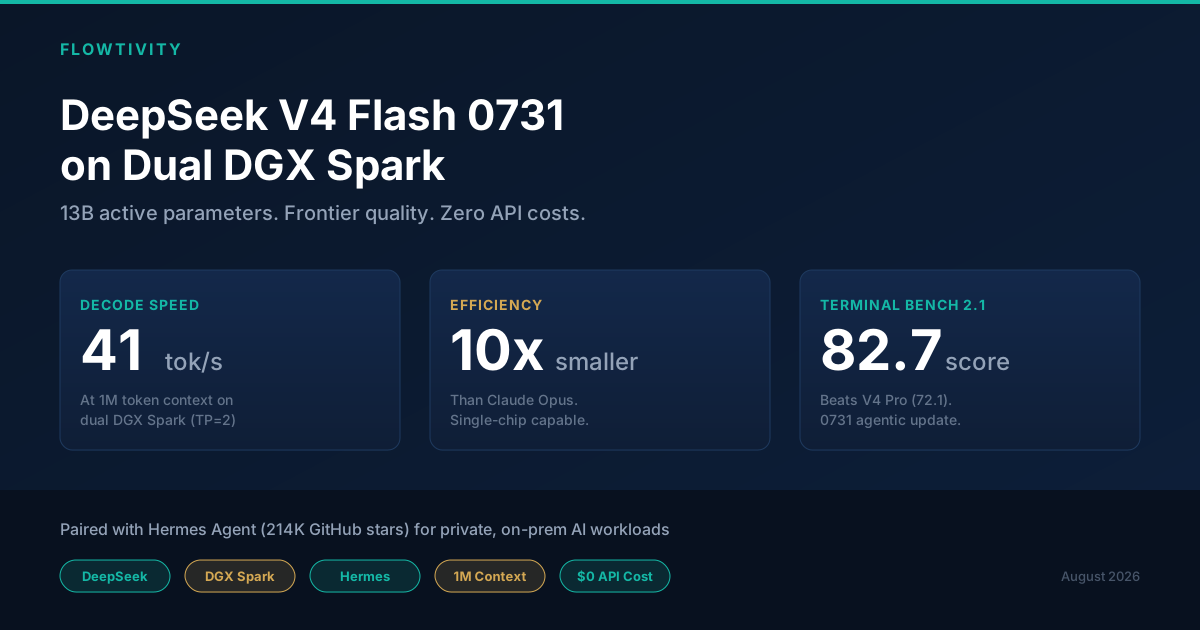
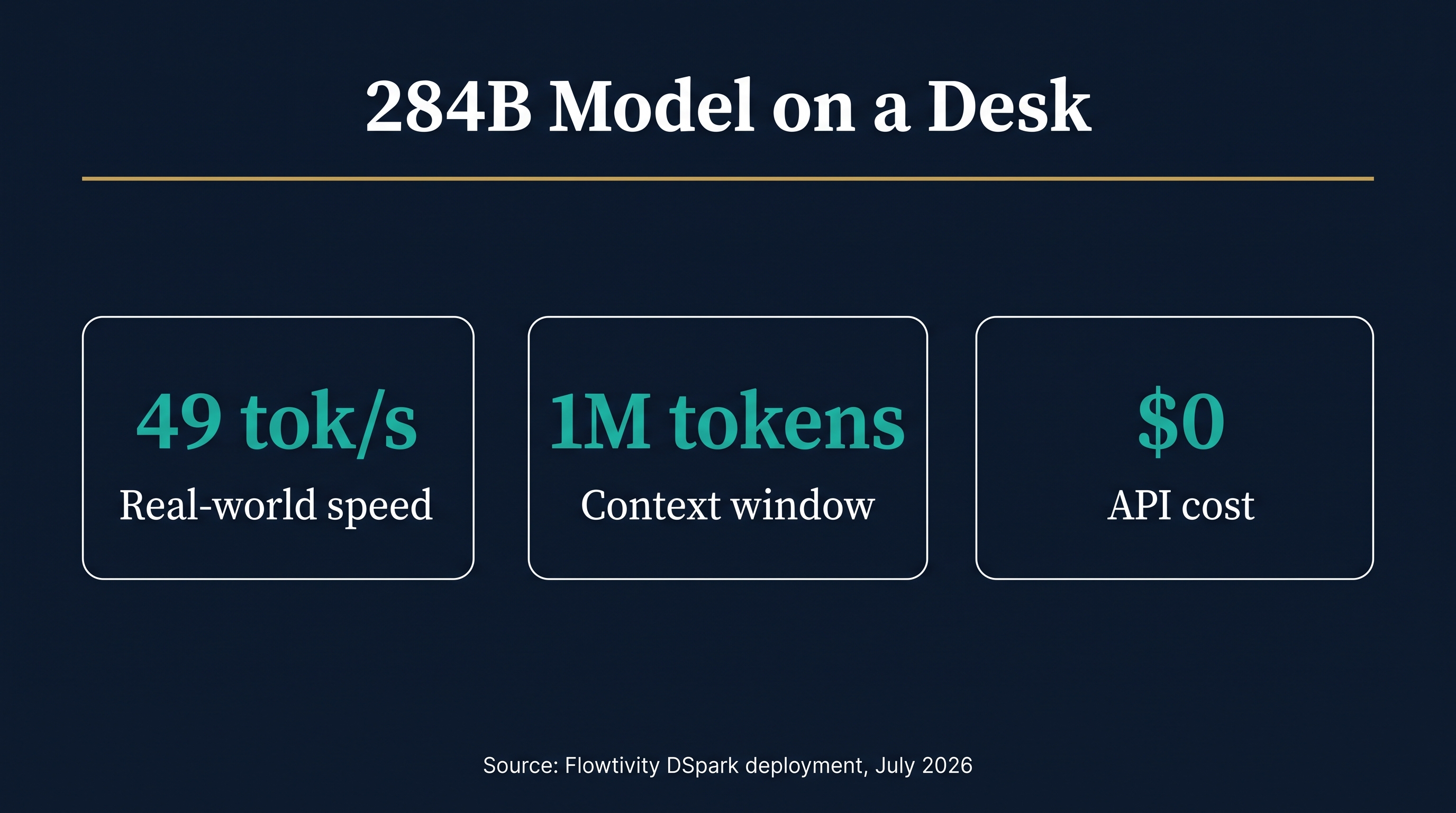
We run a DGX Spark in our own stack, driving the open-source dsh harness with DeepSeek V4 Flash at roughly 50 tokens per second sustained, including a single 46-minute agent turn that consumed 8.9 million input tokens at effectively zero marginal cost. That is the economics Portable Computer productizes for people who do not want to assemble their own stack. The choice now splits cleanly: a curated, sandboxed, closed appliance from Perplexity that just works, versus an open composable ecosystem like dsh with more than 10,000 community plugins where you own every layer. We lean open for the same reason we build on open frameworks, but for compliance-heavy teams that want local agents without a platform engineer, Portable Computer is the first packaged product that takes the thesis seriously. You can read our hands-on dsh experience for the open-route counterpoint.
Frequently Asked Questions
Related reading: why the DeepSeek harness is the new meta for AI agents, our hands-on dsh experience building a Fireflies-style plugin, our DGX Spark model review, and our guide to building your own private AI infrastructure.
What's actually useful in AI, every Friday
We follow everything happening in AI and send what's worth your time: new models, AI agents, and how to put them to work. One email a week, unsubscribe anytime.