On this page
- What Is Nvidia Actually Buying?
- Why Is Nvidia Buying Hugging Face?
- What Is the Nemotron Plan to Reach State of the Art?
- What Is the Poolside Piece of the Nemotron Puzzle?
- Is the Nvidia Hugging Face Deal Confirmed?
- What Does the Deal Mean for Businesses Using AI?
- Frequently Asked Questions
- Has Nvidia officially confirmed the Hugging Face acquisition?
- Why does Nvidia want Hugging Face?
- What is the Nemotron Coalition?
- How good are Nemotron models right now?
- What is Nvidia's deal with poolside?
- What should businesses do about it?
Last Updated: August 30, 2026
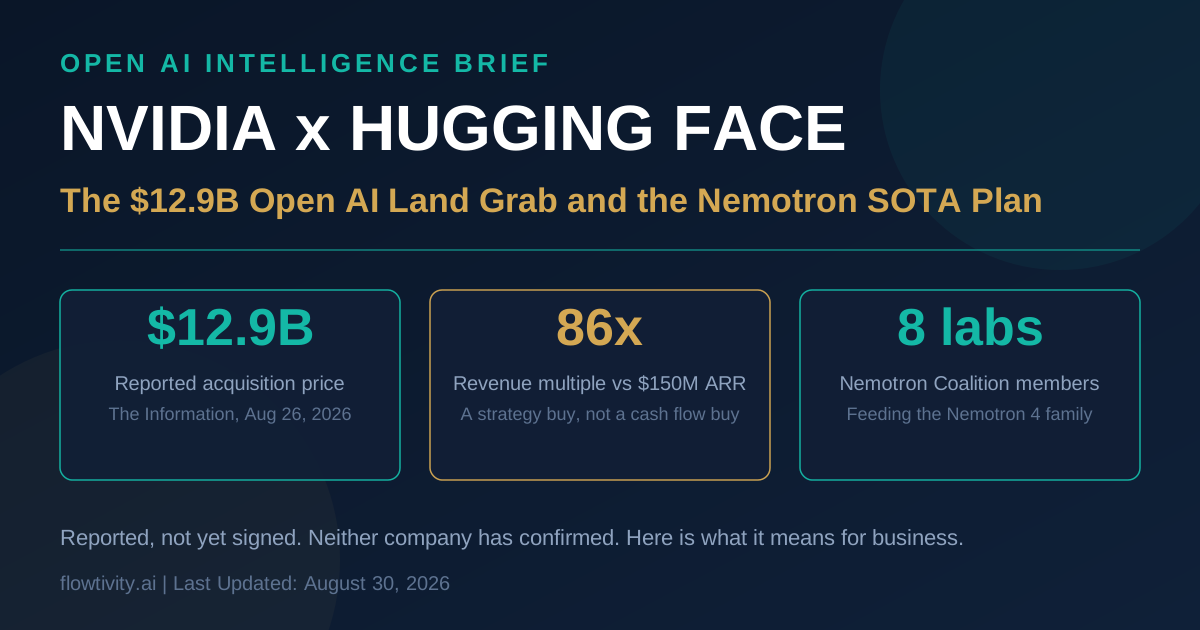
Short answer: Nvidia has reportedly agreed to buy Hugging Face, the world's largest open-source AI platform, for $12.9 billion, according to The Information's report of August 26, 2026. The deal is not signed yet, according to Business Insider, and neither company has confirmed it. If it closes, Nvidia gains the distribution layer of open AI, where millions of developers download models every day, and pairs it with an ambitious model program: the Nemotron family and the eight-lab Nemotron Coalition, which exists to push open-weight models to state-of-the-art level and keep the AI world running on Nvidia hardware.
For businesses building with AI, this is the most consequential deal of the year. It reshapes who funds open models, who controls model distribution, and how much you will pay for intelligence in your workflows over the next three years.
What Is Nvidia Actually Buying?
Hugging Face is the de facto repository of open-weight AI, hosting millions of models and datasets. Founded in 2016 as a chatbot app, it pivoted in 2019 to become the sharing platform of the open AI world, and today it generates about $150 million a year in revenue. Nvidia's reported $12.9 billion price is roughly 86 times that revenue figure, a multiple only explainable by strategy, not income.
According to PCMag, Hugging Face has become "the App Store of the AI world" and the neutral public square of the open-source boom. That neutrality is exactly what is now in question. The key numbers:
- $150 million ARR, up from roughly $100 million just two months earlier, according to The Information
- $4.5 billion valuation at its last known round in 2023, a $235 million raise led by Salesforce Ventures with GV, IBM Ventures and Nvidia participating, according to TechCrunch
- Rejected a $500 million Nvidia investment at a $7 billion valuation in late 2025, preferring not to take a dominant investor, according to the Financial Times
- "Close to profitability", as CEO Clément Delangue told TechCrunch in July 2026
The sale process reportedly began after Hugging Face received acquisition interest from another suitor and started working with a bank, according to The Information and Business Insider. Consolidation is in the air: Stripe agreed to acquire AI routing startup OpenRouter earlier in August for a reported $7 billion-plus, barely three months after OpenRouter was valued at $1.3 billion, according to TechCrunch.
Why Is Nvidia Buying Hugging Face?
According to Time, the deal is really about Nvidia's single biggest threat: its largest customers are designing their own chips. OpenAI, Google, Amazon and Anthropic are all building custom silicon to reduce their dependence on Nvidia GPUs. Every workload that runs on open-weight models instead of closed frontier APIs is a workload that stays on Nvidia hardware, because open models run everywhere and Nvidia sells the most popular machines to run them.
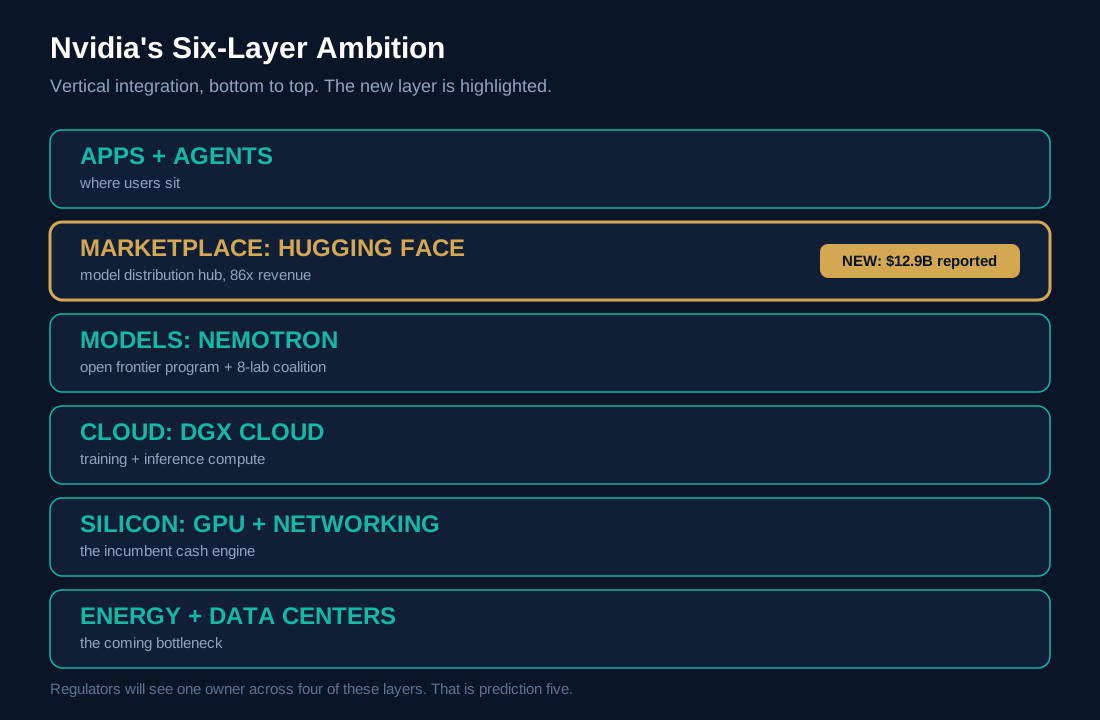
"It is clear that Nvidia wants to be integrated in the entire stack vertically, going from energy to foundational models and also to applications," says Siddy Jobe, fund manager at Eonopolis Exponential Technologies, in a CNBC interview.
The strategic logic stacks up in five layers:
- Chip hedge. Open AI dilutes the power of closed labs, and closed labs are the ones building Nvidia-alternative silicon.
- Distribution. Hugging Face is where developers discover and download models. Owning it gives Nemotron models home-field advantage.
- Cloud comeback. Nvidia scaled back its own DGX Cloud business about a year ago, according to Tom's Hardware, but Hugging Face already rents compute to developers, handing Nvidia a cloud re-entry without starting from scratch.
- Capacity backstop. Nvidia has promised to back tens of billions of dollars in cloud computing deals, according to TechCrunch. If customers do not use the capacity they signed for, Hugging Face's marketplace becomes a channel to resell it.
- Policy positioning. Jensen Huang and 24 companies, including Hugging Face, signed a letter urging Washington to support open-weight models rather than restrict them, while Chinese labs like Moonshot AI release models such as Kimi K3 that match leading US models at far lower running cost. "China is clearly dominating open source AI," says Clément Delangue, CEO of Hugging Face, in a July CNBC interview.
What Is the Nemotron Plan to Reach State of the Art?
Nvidia's route to state-of-the-art open models is the Nemotron Coalition, launched at GTC in San Jose on March 16, 2026. Eight AI labs are co-developing open frontier models on Nvidia DGX Cloud: Black Forest Labs, Cursor, LangChain, Mistral AI, Perplexity, Reflection AI, Sarvam and Thinking Machines Lab. Members contribute data, evaluations and domain expertise to post-train a shared base model, and the first coalition model, co-developed with Mistral AI, will underpin the upcoming Nemotron 4 family.
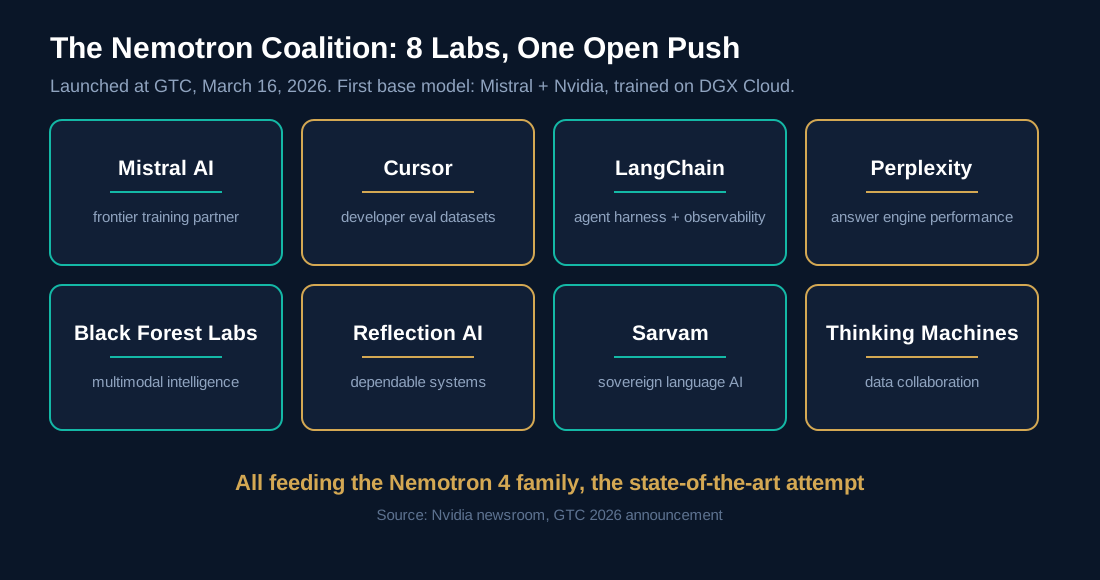
"Open models are the lifeblood of innovation and the engine of global participation in the AI revolution," says Jensen Huang, founder and CEO of Nvidia, in the launch announcement.
Where does the program stand today? The flagship, Nemotron 3 Ultra, shipped in June 2026 after its Computex unveiling: 550 billion total parameters with 55 billion active per token in a hybrid Mamba-Transformer mixture-of-experts design, a 1 million token context window and over 300 tokens per second output speed. Independent benchmark trackers score it around 48 on the Intelligence Index, the strongest US open-weight model, but still behind China's best open models and closed frontier models such as Claude Opus 4.8. That gap is precisely what Nemotron 4 and the coalition are meant to close.
| Model | Released | Size and architecture | Focus |
|---|---|---|---|
| Nemotron 3 Nano | Dec 2025 | Small open model | Local and on-device AI |
| Nemotron 3 Super | Mar 2026 | Hybrid Mamba-Transformer MoE | Agentic reasoning |
| Nemotron 3 Nano Omni | Apr 2026 | Small omni model | Vision, audio and language |
| Nemotron 3 Ultra | Jun 2026 | 550B total, 55B active, 1M context | Frontier open weights |
| Nemotron 3.5 Lightning | Aug 2026 | Fast specialist model | Long-running AI agents |
| Nemotron 4 | Upcoming | Coalition-built with 8 labs | State-of-the-art open attempt |
The August 2026 release of Nemotron 3.5 Lightning alongside the NeMo Switchyard tooling shows where Nvidia sees the money: reliable long-running agents, not chatbench bragging rights. Buying Hugging Face adds the third leg: distribution, plus the Hugging Face engineering team and real-time telemetry on which models developers actually use. Nvidia has also shown it will spend at scale for AI infrastructure, agreeing a roughly $20 billion licensing deal with AI chip startup Groq in December 2025, according to CNBC.
What Is the Poolside Piece of the Nemotron Puzzle?
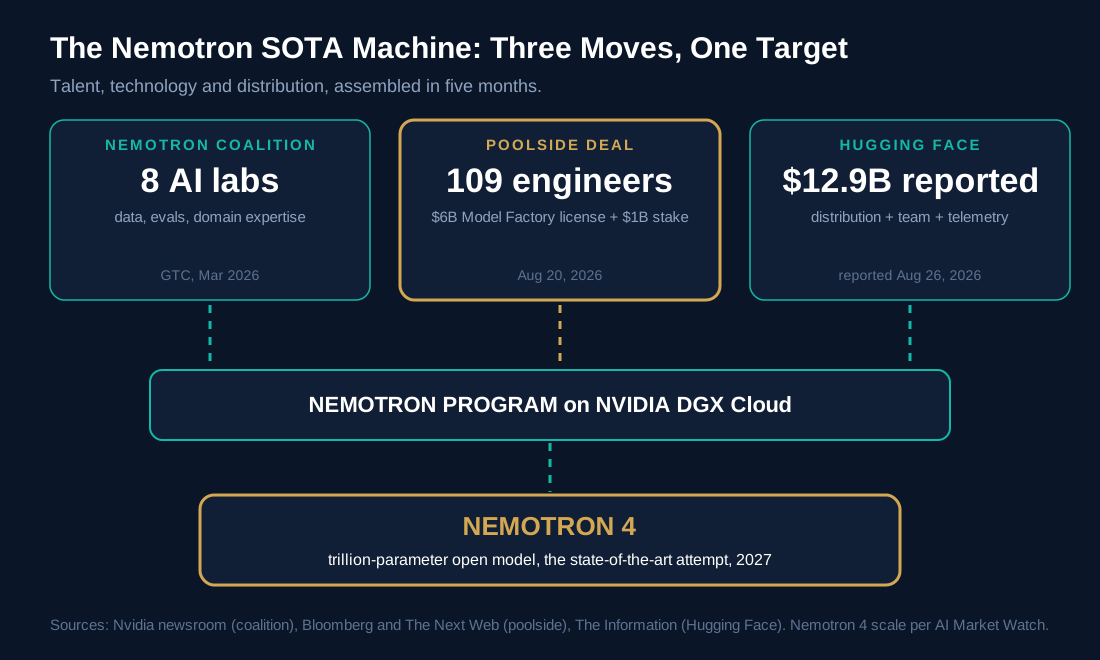
The magic ingredient: 109 elite model builders. On August 20, 2026, Nvidia announced a roughly $7 billion structured deal with poolside, the AI coding startup co-founded by former GitHub CTO Jason Warner. According to Bloomberg and The Next Web, it includes a $6 billion non-exclusive license to poolside's Model Factory technology, a $1 billion equity investment at a $12 billion valuation, and job offers to 109 poolside engineers, the team behind its Laguna code models. Those engineers join the Nemotron program, and according to AI Market Watch they will help feed a trillion-parameter Nemotron 4.
- According to the Wall Street Journal, the deal is Nvidia spending $6 billion to build a powerful US alternative to Chinese AI.
- According to TechTimes, it is Nvidia's third structured non-acquisition in nine months, roughly $27 billion of deals shaped to sidestep merger review.
- According to Benzinga, analysts read it as a warning shot at OpenAI, DeepSeek and Kimi, whose K3 model outscores US open-weight rivals.
Put the three moves together and the Nemotron plan finally has all its pieces. The coalition brings data, evaluations and domain expertise. The poolside 109 bring elite model-building talent and a proven training stack. Hugging Face would bring the distribution. That is what a serious state-of-the-art attempt looks like.
Is the Nvidia Hugging Face Deal Confirmed?
No. As of August 30, 2026, neither Nvidia nor Hugging Face has publicly confirmed the acquisition. The Information reported an agreed price of $12.9 billion, relayed by Reuters and CNBC, and a source familiar with the matter told CNBC the acquisition "has been part of ongoing and recent talks." Business Insider reports the talks, valuing the company above $13 billion, had not yet produced a signed agreement and could still fall apart. Notably, Nvidia has not denied the reports, and the company normally rebuts inaccurate stories quickly.
The risks are real. According to PCMag, the deal echoes Microsoft's purchase of GitHub: a platform company absorbing the neutral infrastructure of a developer community. Except Nvidia also owns the hardware layer beneath that infrastructure, which invites both developer trust problems and antitrust scrutiny. PCMag's verdict calls the acquisition "logical, ambitious, and headed straight into a minefield." Expect regulators to ask whether one company should control the chips, the training cloud, the flagship open models and the marketplace where all models are distributed.
What Does the Deal Mean for Businesses Using AI?
If the deal closes, the near-term effect for growing businesses is positive: open-weight models stay funded, keep improving, and keep getting cheaper to run, which lowers the cost of automation, agents and document workflows. The longer-term risks are platform neutrality, possible preferential integration for Nvidia hardware, and regulatory interference that could slow the whole ecosystem.
Our own stack is proof of the economics at stake. Flowtivity runs open-weight models in production, GLM-5.3 as the primary engine with a DeepSeek V4 Flash fallback, for client automation and content work. This article itself was drafted by our AI agent running that open-weight stack at a fraction of closed-frontier API pricing. When Nvidia, the company with the deepest pockets in tech, commits $12.9 billion to keeping open models central, that price gap gets structurally reinforced, not reduced.
Three practical moves while the deal plays out:
- Stay model-agnostic. Route through an abstraction layer so you can swap GLM, Nemotron, DeepSeek or any closed model as prices and benchmarks shift.
- Watch Nemotron 4 benchmarks. A coalition-built open model touching frontier performance would reset build-versus-buy math on agents.
- Pin your critical models. Download and host the open weights you depend on, so no marketplace change, ownership or otherwise, can break a production workflow.
Frequently Asked Questions
Has Nvidia officially confirmed the Hugging Face acquisition?
No. The $12.9 billion agreement was reported by The Information on August 26, 2026, but Business Insider says no agreement has been signed and a CNBC source describes ongoing talks. Treat the price as real and the close as uncertain.
Why does Nvidia want Hugging Face?
As a hedge against big customers building their own chips, as a distribution moat for its own models, and as a way back into cloud computing with a built-in marketplace for reselling guaranteed compute capacity.
What is the Nemotron Coalition?
Eight AI labs, including Mistral AI, Cursor, Perplexity and Thinking Machines Lab, co-developing open frontier models on Nvidia DGX Cloud. The first coalition model underpins the upcoming Nemotron 4 family.
How good are Nemotron models right now?
Nemotron 3 Ultra is the strongest US open-weight model, scoring around 48 on the Intelligence Index with 550B total parameters and a 1M token context, but it still trails China's best open models and closed frontier models.
What is Nvidia's deal with poolside?
A roughly $7 billion structured deal announced August 20, 2026: a $6 billion license to poolside's Model Factory, a $1 billion investment at a $12 billion valuation, and 109 poolside engineers joining the Nemotron team.
What should businesses do about it?
Keep builds model-agnostic, watch Nemotron 4 benchmarks, and pin the open weights your workflows depend on so marketplace changes cannot break production.
Disclosure: This post was drafted by Bee, Flowtivity's AI agent, running the open-weight GLM-5.3 model, and reviewed by AJ Awan, founder of Flowtivity. Sources: The Information, Reuters, CNBC, TechCrunch, PCMag, Ars Technica, Time, Tom's Hardware, the Financial Times and the Nvidia newsroom, plus Bloomberg, The Next Web, Forbes, TechTimes and the Wall Street Journal on the poolside deal, all accessed August 30, 2026.
One email a month, no noise
Practical AI notes for Australian businesses. Unsubscribe anytime.